2.19 Measuring transpiration with a potometer
How to set up a bubble potometer, measure how far the air bubble moves, calculate the rate of water uptake (including volume from the tube radius), and why water uptake is not exactly the same as transpiration.
What a potometer measures
Key terms
- Potometer: apparatus that measures how fast a leafy shoot takes up water.
- Rate of water uptake: the distance the bubble moves, or the volume of water taken up, per unit time.
As water is lost from the leaves by transpiration, the shoot draws up more water. In a bubble potometer, an air bubble in a narrow tube moves as the water is taken up. The faster the bubble moves, the faster the rate of transpiration.
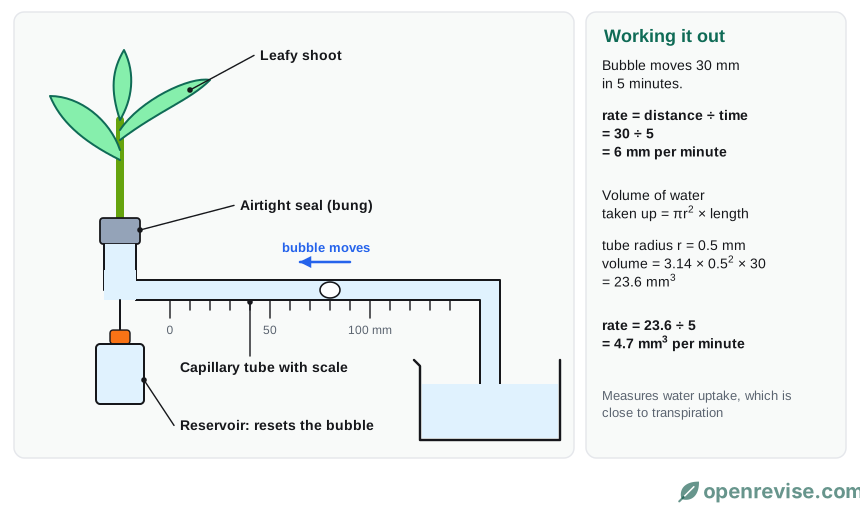
Method
- Cut a leafy shoot under water, at a slant. This stops air getting into the xylem, which would block the flow of water.
- Set up the potometer under water and push the shoot into the bung, so there are no air bubbles in the apparatus.
- Take it out of the water and dry the leaves. Seal the joints with petroleum jelly so the apparatus is airtight.
- Let one air bubble into the end of the capillary tube.
- Record the distance the bubble moves along the scale in a set time, for example 5 minutes.
- Use the reservoir tap to push the bubble back to the start, and repeat to get a mean.
- Change one factor at a time, such as light intensity (move a lamp), air movement (a fan) or temperature, keeping the others the same.
Calculating the rate
Example: the bubble moves 30 mm in 5 minutes. Rate = 30 ÷ 5 = 6 mm per minute.
To find the volume of water taken up, treat the water in the tube as a cylinder:
If the tube's radius is 0.5 mm, the volume = 3.14 × 0.52 × 30 = 23.6 mm3, so the rate is 23.6 ÷ 5 = 4.7 mm3 per minute.
Why it is not exactly transpiration
A potometer measures water uptake, not water loss. They are close, but not the same, because a small amount of the water taken up is used by the plant in photosynthesis and to keep its cells turgid.
Test yourself on this lesson
6 exam questions · 13 marks · with mark schemes and model answers
Found a mistake?