2.18 Transpiration and translocation
How water moves through a plant in the transpiration stream, how light intensity, temperature, air movement and humidity change the rate of transpiration, and how sugars are moved by translocation in the phloem.
Transpiration
Key terms
- Transpiration: the loss of water vapour from the leaves of a plant, mainly through the stomata.
- Transpiration stream: the movement of water from the roots, up the xylem and out of the leaves.
- Translocation: the movement of dissolved sugars around the plant in the phloem.
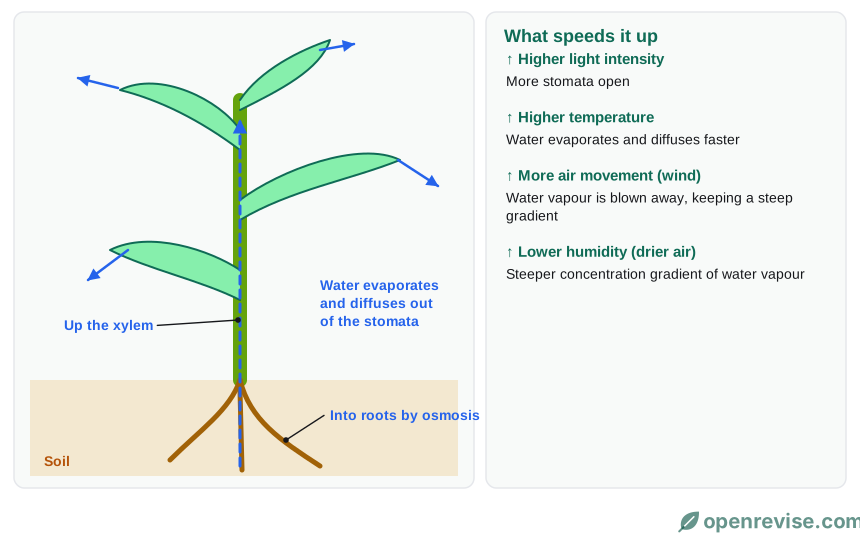
- Water evaporates from the surfaces of the mesophyll cells into the air spaces in the leaf.
- The water vapour diffuses out of the leaf through the open stomata.
- This pulls more water up the xylem to replace it, like drinking through a straw.
- More water enters the root hair cells by osmosis from the soil.
The transpiration stream gives the plant the water it needs for photosynthesis, carries mineral ions from the roots to the leaves, keeps cells firm (turgid) so the plant does not wilt, and cools the leaves as water evaporates.
Factors that affect the rate of transpiration
| Factor | Effect on rate | Why |
|---|---|---|
| Light intensity | Brighter light: faster | More stomata open to let carbon dioxide in for photosynthesis |
| Temperature | Warmer: faster | Water molecules have more energy, so they evaporate and diffuse faster |
| Air movement | Windier: faster | Water vapour is blown away from the leaf, keeping a steep concentration gradient |
| Humidity | More humid: slower | The air already contains a lot of water vapour, so the concentration gradient is shallower |
Controlling water loss
The plant can reduce water loss by closing its stomata: the guard cells lose water and close the pores. The waxy cuticle waterproofs the leaf, and most stomata are on the shaded lower surface. Closing the stomata also stops carbon dioxide getting in, so photosynthesis slows down.
Translocation
Sugars made by photosynthesis in the leaves are converted to sucrose and carried in the phloem to:
- growing regions, such as shoot tips and young leaves, where they are used in respiration and to make new cells
- storage organs, such as potatoes and other tubers, where they are stored as starch.
Translocation can go up or down the plant, wherever sugars are needed. Unlike transpiration, it needs energy, supplied by the companion cells.
Test yourself on this lesson
6 exam questions · 13 marks · with mark schemes and model answers
Found a mistake?