2.16 Plant tissues and the leaf
The leaf as a plant organ: the epidermis, palisade and spongy mesophyll, xylem, phloem and meristem tissues, and how guard cells open and close the stomata, with how each is adapted for photosynthesis and gas exchange.
Plant tissues
The leaf is a plant organ: it is made of several tissues that work together to carry out photosynthesis. The stem and roots are organs too.
Key terms
- Epidermal tissue: covers the plant. In leaves it is covered with a waxy cuticle.
- Palisade mesophyll: tall cells packed with chloroplasts, where most photosynthesis happens.
- Spongy mesophyll: loosely packed cells with air spaces between them, for gas exchange.
- Xylem and phloem: transport tissues. Xylem carries water and mineral ions; phloem carries dissolved sugars.
- Meristem: tissue at the tips of shoots and roots where cells divide to make new cells.
- Stomata: tiny pores, mostly on the lower surface of the leaf, that let gases in and out (singular: stoma).
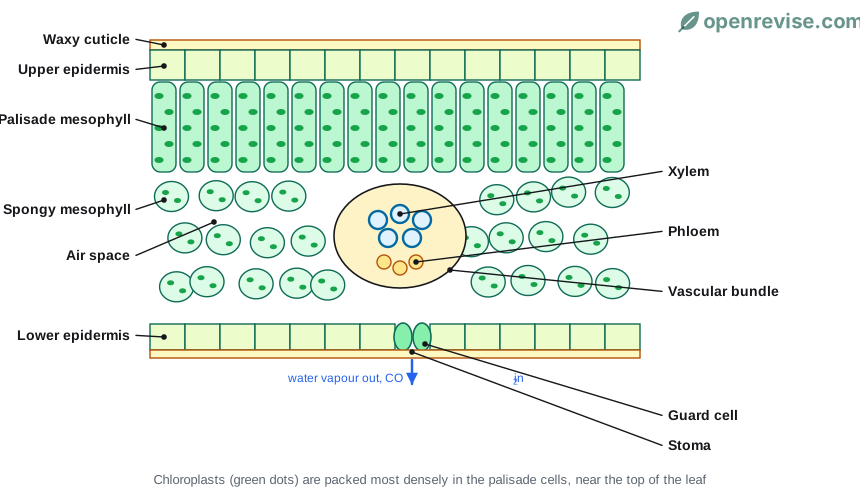
How the leaf is adapted
| Tissue | Adaptation | Why it helps |
|---|---|---|
| Waxy cuticle | Waterproof layer on top | Reduces water loss by evaporation |
| Upper epidermis | Thin and transparent | Lets light through to the palisade cells |
| Palisade mesophyll | Tall cells near the top, packed with chloroplasts | Absorb as much light as possible for photosynthesis |
| Spongy mesophyll | Air spaces between cells | Carbon dioxide diffuses to the cells and oxygen diffuses out; large surface area |
| Xylem and phloem | Form a network of veins | Bring water to the leaf and take sugars away |
| Lower epidermis | Contains stomata and guard cells | Gas exchange, controlled to save water |
Guard cells and stomata
Each stoma is surrounded by two guard cells, which control its size.
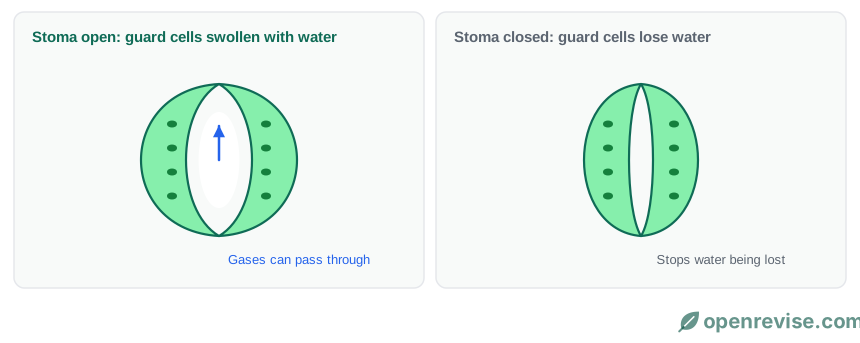
- When the plant has plenty of water, the guard cells take in water, swell and bend apart, so the stoma opens. Carbon dioxide can diffuse in for photosynthesis, and oxygen and water vapour diffuse out.
- When the plant is short of water, the guard cells lose water, become flaccid and close the stoma. This reduces water loss.
- Stomata usually close at night, when there is no light for photosynthesis.
Most stomata are on the lower surface of the leaf, which is cooler and shaded, so less water evaporates.
Meristem tissue
Meristem tissue at the tips of roots and shoots contains stem cells that divide by mitosis. They can differentiate into any type of plant cell, so plants keep growing throughout their lives.
Test yourself on this lesson
6 exam questions · 11 marks · with mark schemes and model answers
Found a mistake?