2.17 Root hair cells, xylem and phloem
How root hair cells take up water by osmosis and mineral ions by active transport, and how xylem (dead, lignified, hollow tubes) and phloem (living sieve tube cells with sieve plates) are adapted to transport water and sugars.
AQA
Edexcel
OCR
2 min read
Transport in plants
Plants need to move two things around:
- water and mineral ions, taken up from the soil by the roots and carried to every part of the plant in the xylem
- dissolved sugars, made in the leaves by photosynthesis and carried to where they are used or stored in the phloem.
Key terms
- Root hair cell: a specialised cell on the surface of a root, with a long extension that takes up water and mineral ions.
- Xylem: a tissue of hollow tubes made of dead cells, which carries water and mineral ions from the roots to the leaves.
- Phloem: a tissue of living cells that carries dissolved sugars around the plant.
- Lignin: a tough substance that strengthens the walls of xylem cells.
- Translocation: the movement of dissolved sugars through the phloem.
Root hair cells
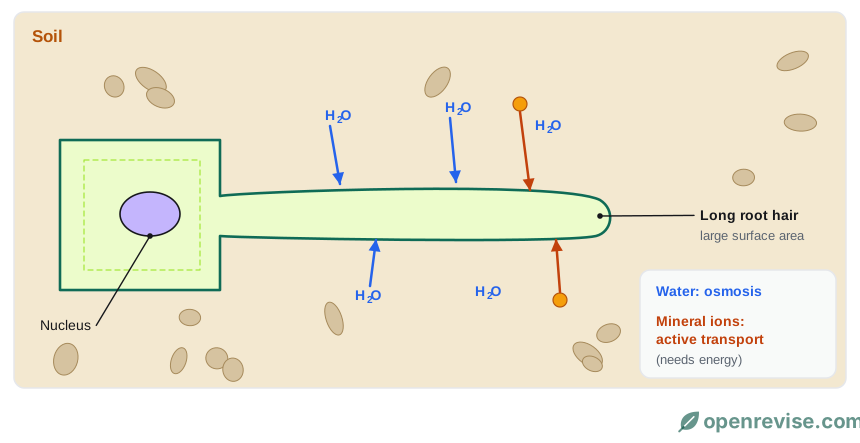
- The long root hair gives a very large surface area for absorbing water and mineral ions. Millions of root hairs make the total area enormous.
- Water moves in by osmosis, because the cytoplasm of the root hair is more concentrated than the soil water.
- Mineral ions, such as nitrate and magnesium, are usually at a lower concentration in the soil than in the cell, so they must be taken in by active transport. This needs energy from respiration, so root hair cells have many mitochondria.
- Root hair cells have no chloroplasts: they are underground, where there is no light.
Xylem
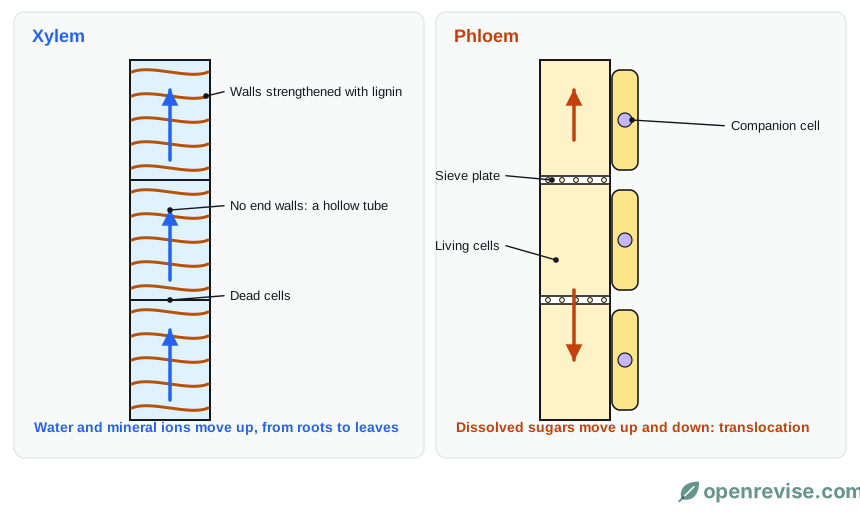
- Xylem is made of dead cells joined end to end.
- The end walls have broken down, so the cells form a long hollow tube that water flows through easily.
- The walls are strengthened with rings or spirals of lignin, so the tubes do not collapse and they help support the plant.
- Water and mineral ions only travel upwards, from the roots to the leaves. This is the transpiration stream.
Phloem
- Phloem is made of living cells called sieve tube elements, joined end to end.
- Their end walls have pores, forming sieve plates, so dissolved sugars can flow from one cell to the next.
- The sieve tube cells have very little cytoplasm and no nucleus. Companion cells next to them have mitochondria and supply the energy they need.
- Sugars move both up and down the plant: from the leaves to growing tips, roots and storage organs. This is translocation.
Test yourself on this lesson
6 exam questions · 14 marks · with mark schemes and model answers
Found a mistake?