2.11 Blood vessels
How the structures of arteries, veins and capillaries suit their jobs: thick elastic walls for high pressure, valves and wide lumens for low pressure, and walls one cell thick for exchange, plus how to calculate the rate of blood flow.
Three types of blood vessel
Key terms
- Artery: a blood vessel that carries blood away from the heart, at high pressure.
- Vein: a blood vessel that carries blood back to the heart, at low pressure.
- Capillary: a tiny blood vessel where substances are exchanged with body cells.
- Lumen: the space inside a blood vessel, where the blood flows.
Blood leaves the heart in arteries. These branch into capillaries, which run through every tissue. Capillaries join up to form veins, which take the blood back to the heart.
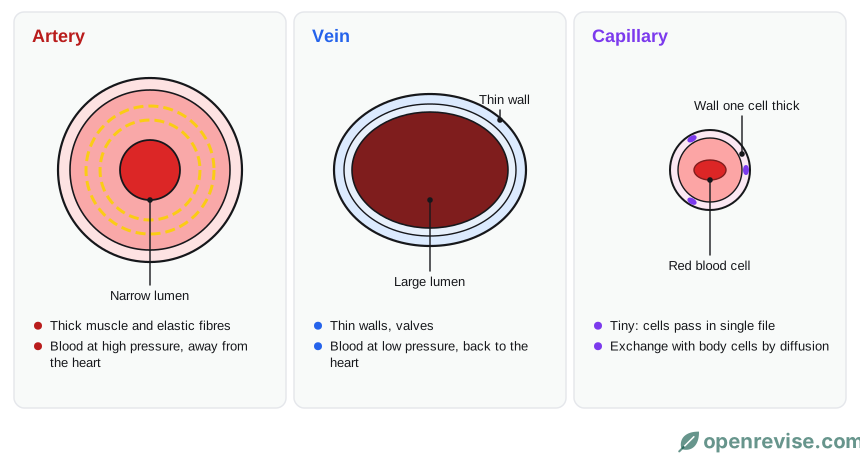
| Vessel | Structure | Why |
|---|---|---|
| Artery | Thick walls of muscle and elastic fibres; narrow lumen | Withstands the high pressure from the heart; elastic fibres stretch and recoil with each beat |
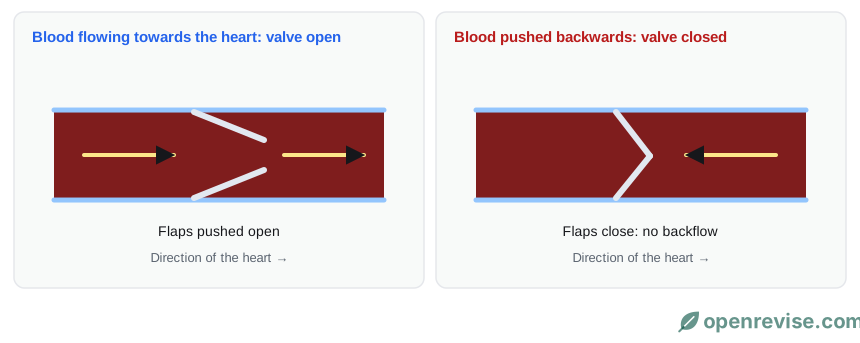
| Vein | Thin walls; large lumen; valves | Blood is at low pressure; the large lumen lets it flow easily; valves stop it flowing backwards |
| Capillary | Wall one cell thick; very narrow; huge numbers | Short diffusion distance for exchange; reaches every cell |
Valves in veins
The pressure in veins is low, so blood could flow backwards, especially in the legs. Valves stop this. Body muscles squeeze the veins as they contract, pushing the blood towards the heart.
Exchange in capillaries
Capillary walls are one cell thick and are often leaky. Oxygen, glucose and other substances diffuse out of the blood into the body cells, and carbon dioxide and urea diffuse from the cells into the blood. Capillaries are so narrow that red blood cells pass in single file, close to the wall.
Rate of blood flow
Example: 2400 cm3 of blood flows through an artery in 4 minutes. Rate = 2400 ÷ 4 = 600 cm3 per minute. Blood flow is fastest in arteries and slowest in capillaries, which gives more time for exchange.
Test yourself on this lesson
6 exam questions · 12 marks · with mark schemes and model answers
Found a mistake?