2.10 Heart rate and cardiac output
Edexcel: calculating cardiac output from stroke volume and heart rate, rearranging the equation, measuring heart rate from the pulse, and why cardiac output rises during exercise.
Key terms
Key terms
- Heart rate: the number of times the heart beats in one minute (beats per minute, bpm).
- Stroke volume: the volume of blood pumped out of the left ventricle in one heartbeat (cm3).
- Cardiac output: the volume of blood pumped by the heart in one minute (cm3 per minute).
The equation
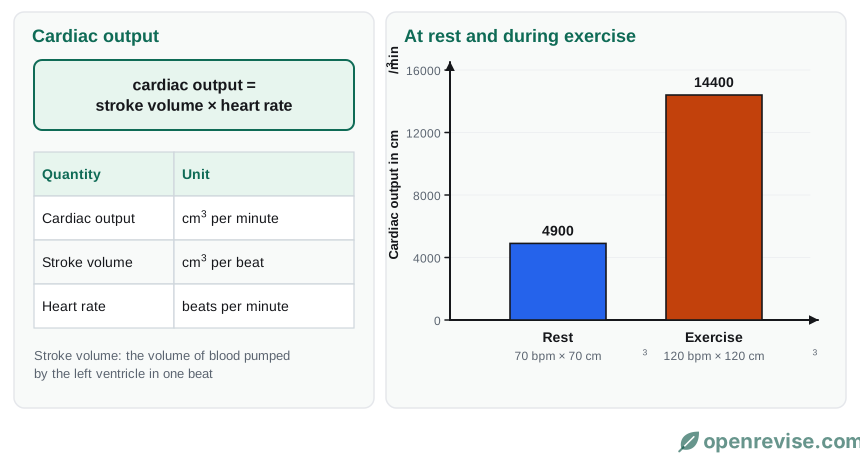
Example: at rest, a person's heart rate is 70 beats per minute and their stroke volume is 70 cm3. Cardiac output = 70 × 70 = 4900 cm3 per minute (4.9 dm3 per minute).
You may need to rearrange the equation:
Example: cardiac output is 6000 cm3 per minute and heart rate is 80 bpm. Stroke volume = 6000 ÷ 80 = 75 cm3.
Measuring heart rate
Each heartbeat sends a surge of blood through the arteries, which you can feel as a pulse in the wrist or neck. Count the beats in 15 seconds and multiply by 4 to get the beats per minute. A heart rate monitor gives a more precise value.
During exercise
Muscles need more energy, so they respire faster. They need more oxygen and glucose, and they make more carbon dioxide that must be removed. So during exercise:
- the heart rate increases
- the stroke volume increases, because the heart contracts more strongly
- so the cardiac output increases, and blood flows to the muscles faster.
People who exercise regularly often have a larger stroke volume, so their heart can supply the same cardiac output at rest with a lower resting heart rate.
Test yourself on this lesson
6 exam questions · 14 marks · with mark schemes and model answers
Found a mistake?