1.1 Atoms, elements, compounds and mixtures
What atoms, elements, compounds and mixtures are, how to read chemical symbols and formulae, and why compounds can only be separated by chemical reactions while mixtures can be separated by physical processes.
Atoms and elements
Key terms
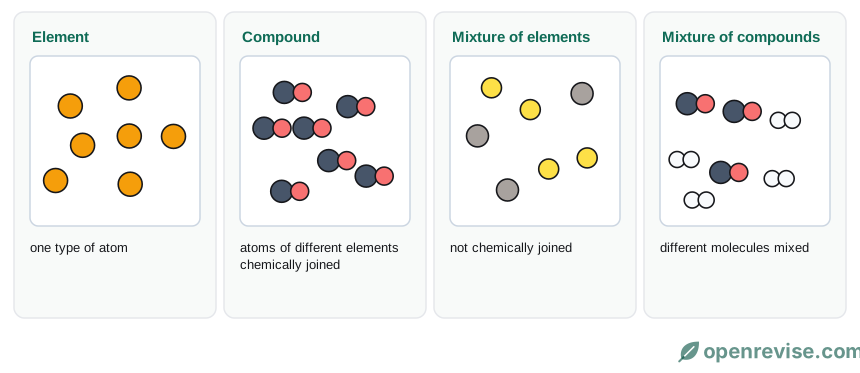
- Atom: the smallest part of an element that can exist.
- Element: a substance made of only one type of atom.
- Compound: a substance made of two or more different elements chemically combined in fixed proportions.
- Mixture: two or more elements or compounds that are not chemically combined.
All substances are made of atoms. There are about 100 different elements, each made of one type of atom, and each with a symbol: for example O for oxygen and Na for sodium. The elements are shown in the periodic table.
Compounds and formulae
Compounds form when elements react together. They contain two or more elements chemically combined in fixed proportions, shown by a formula:
- H2O: 2 hydrogen atoms and 1 oxygen atom
- CO2: 1 carbon atom and 2 oxygen atoms
- NaCl: sodium and chlorine in a 1:1 ratio.
A compound has different properties from the elements it is made of: sodium is a reactive metal and chlorine is a toxic gas, but sodium chloride is table salt. Compounds can only be separated into elements by chemical reactions.
Mixtures
In a mixture, the substances are not chemically joined, so each keeps its own properties. Air, sea water and crude oil are mixtures. Mixtures can be separated by physical processes, without chemical reactions:
- filtration
- crystallisation
- simple distillation
- fractional distillation
- chromatography.
| Compound | Mixture |
|---|---|
| Elements chemically combined | Substances not chemically combined |
| Fixed proportions | Any proportions |
| New properties | Each part keeps its properties |
| Separated by chemical reactions | Separated by physical processes |
Test yourself on this lesson
5 exam questions · 11 marks · with mark schemes and model answers
Found a mistake?