1.2 Word and balanced symbol equations
How to write word equations and balanced symbol equations, why equations must balance (conservation of mass), how to balance them by changing the numbers in front of formulae, and how to add state symbols.
Writing equations
Key terms
- Reactant: a substance that reacts, written on the left of an equation.
- Product: a substance made in a reaction, written on the right.
- Balanced equation: an equation with the same number of atoms of each element on both sides.
- State symbol: a label showing the state of a substance: (s) solid, (l) liquid, (g) gas, (aq) dissolved in water.
A word equation shows the names of the reactants and products:
A symbol equation uses formulae. Because atoms are not created or destroyed in a reaction (conservation of mass), the equation must be balanced.
How to balance an equation
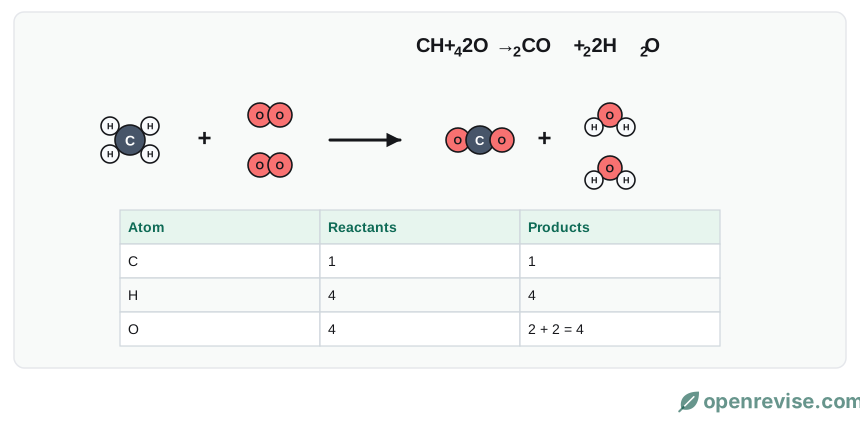
- Write the correct formulae: CH4 + O2 → CO2 + H2O.
- Count the atoms of each element on each side.
- Add big numbers in front of formulae to balance them, one element at a time. There are 4 H on the left, so put 2 in front of H2O. Now there are 4 O on the right, so put 2 in front of O2.
- Check every element again: CH4 + 2O2 → CO2 + 2H2O.
Never change the small numbers inside a formula: that would make a different substance.
More examples
- 2Mg + O2 → 2MgO
- Zn + 2HCl → ZnCl2 + H2
- 2Na + 2H2O → 2NaOH + H2
State symbols
Mg(s) + 2HCl(aq) → MgCl2(aq) + H2(g)
The state symbols show that solid magnesium reacts with hydrochloric acid solution to make a solution of magnesium chloride and hydrogen gas.
Test yourself on this lesson
6 exam questions · 9 marks · with mark schemes and model answers
Found a mistake?