2.8 Giant covalent structures: diamond, graphite and silicon dioxide
The structures of diamond, graphite and silicon dioxide, why giant covalent substances have very high melting points, why diamond is hard and graphite is soft and conducts electricity, and how these properties match their uses.
Giant covalent structures
Key terms
- Giant covalent structure: a huge network of atoms all joined by strong covalent bonds, such as diamond, graphite and silicon dioxide.
- Allotropes: different structural forms of the same element, such as diamond and graphite (both pure carbon).
In a giant covalent structure, every atom is joined to others by strong covalent bonds. To melt it, many covalent bonds must be broken, which needs a huge amount of energy. So giant covalent substances have very high melting and boiling points.
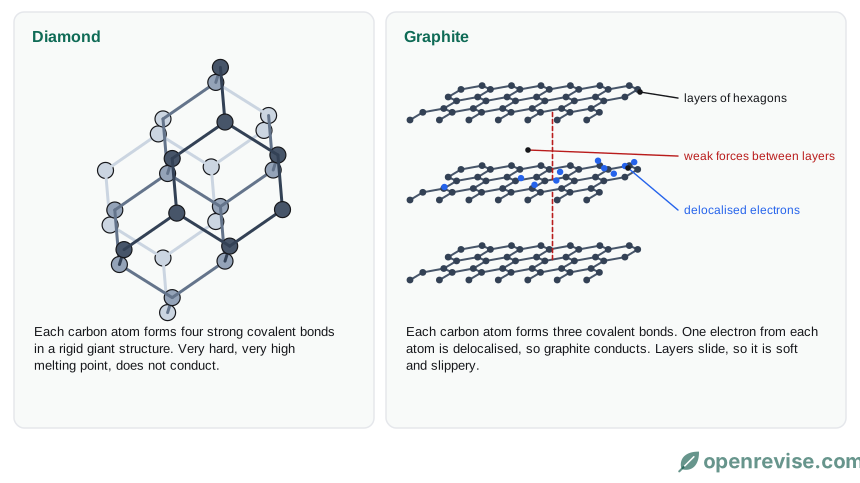
Diamond
- Each carbon atom forms four strong covalent bonds to other carbon atoms.
- The rigid 3D network makes diamond very hard: used in cutting tools and drill tips.
- Very high melting point.
- Does not conduct electricity: all the outer electrons are used in bonds, so there are no free electrons.
Graphite
- Each carbon atom forms three covalent bonds, making layers of hexagons.
- There are no covalent bonds between the layers, only weak forces, so the layers can slide over each other. Graphite is soft and slippery: used as a lubricant and in pencils.
- Each carbon atom has one electron that is delocalised. These electrons can move along the layers, so graphite conducts electricity: used for electrodes.
- Very high melting point, because many strong covalent bonds must be broken.
Silicon dioxide
Silicon dioxide (silica, SiO2) is the main compound in sand. Each silicon atom is bonded to four oxygen atoms and each oxygen to two silicon atoms, in a giant structure like diamond. It has a very high melting point and is hard.
| Structure | Melting point | Conducts when solid? | Conducts when molten or dissolved? |
|---|---|---|---|
| Simple molecular | low | no | no |
| Giant ionic | high | no | yes |
| Giant covalent | very high | no (except graphite) | (does not melt or dissolve easily) |
| Metallic | usually high | yes | yes (molten) |
Test yourself on this lesson
6 exam questions · 12 marks · with mark schemes and model answers
Found a mistake?