2.7 Simple molecules and polymers
Why simple molecular substances have low melting and boiling points and do not conduct electricity, how intermolecular forces increase with the size of molecules, and the structure and properties of polymers such as poly(ethene).
Simple molecular substances
Key terms
- Simple molecular substance: a substance made of small molecules, each containing a few atoms joined by covalent bonds, such as water, oxygen and methane.
- Intermolecular forces: the weak forces of attraction between molecules.
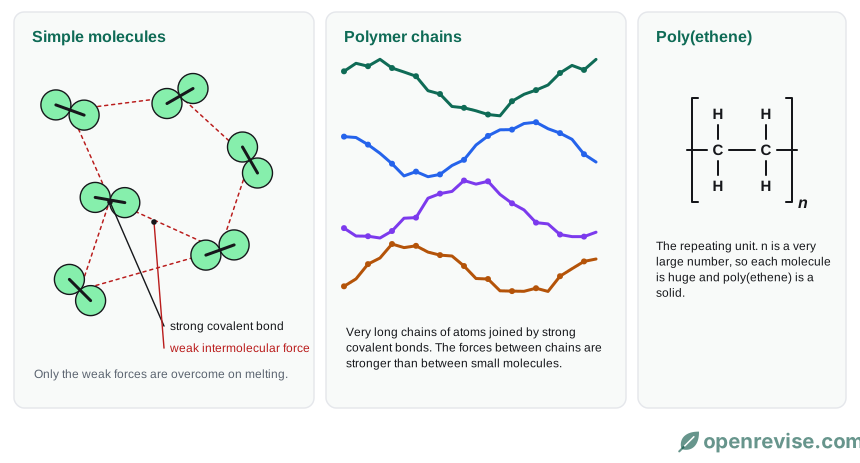
Inside each molecule, the atoms are held together by strong covalent bonds. Between the molecules there are only weak intermolecular forces.
Properties
- Low melting and boiling points: when the substance melts or boils, only the weak intermolecular forces are overcome, which takes little energy. The covalent bonds do not break. Most are gases or liquids at room temperature.
- Do not conduct electricity: the molecules have no overall charge, and there are no free electrons or ions to carry charge.
The intermolecular forces get stronger as the molecules get larger (higher relative molecular mass). So larger molecules have higher melting and boiling points. For example, down Group 7: chlorine is a gas, bromine a liquid and iodine a solid.
Polymers
Key terms
- Polymer: a very large molecule made of many small units (monomers) joined in a long chain.
Polymers such as poly(ethene) consist of very long chains of carbon atoms. Within each chain, the atoms are joined by strong covalent bonds.
Because the molecules are so large, the intermolecular forces between the chains are relatively strong. So polymers are solids at room temperature, with higher melting points than simple molecules.
Poly(ethene) is drawn using its repeating unit: a section of the chain in brackets, with n showing that it repeats many times.
| Feature | Simple molecules | Polymers |
|---|---|---|
| Size of molecule | a few atoms | thousands of atoms |
| Bonds within molecules | strong covalent | strong covalent |
| Forces between molecules | weak | stronger |
| State at room temperature | usually gas or liquid | solid |
| Conduct electricity? | no | no |
Test yourself on this lesson
5 exam questions · 10 marks · with mark schemes and model answers
Found a mistake?