8.5 Flame tests and metal hydroxides
How to identify metal ions using flame tests and the colours of their hydroxide precipitates with sodium hydroxide solution, and the test for ammonium ions.
Flame tests
Key terms
- Flame test: a test for some metal ions, which give a characteristic colour when heated in a flame.
- Clean a nichrome wire loop by dipping it in hydrochloric acid and holding it in a blue Bunsen flame until it gives no colour.
- Dip the loop into the solid sample (or a solution of it).
- Hold it in the blue flame and observe the colour.
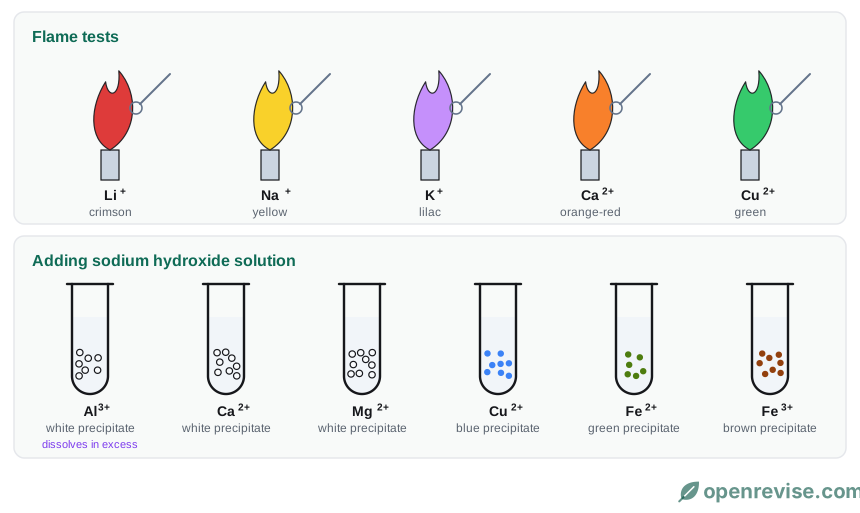
| Metal ion | Flame colour |
|---|---|
| lithium, \mathrm{Li^+} | crimson |
| sodium, \mathrm{Na^+} | yellow |
| potassium, \mathrm{K^+} | lilac |
| calcium, \mathrm{Ca^{2+}} | orange-red |
| copper, \mathrm{Cu^{2+}} | green |
If a sample contains a mixture of metal ions, the flame colours of some ions may be hidden by others (for example, sodium's strong yellow).
Metal hydroxide precipitates
Add a few drops of sodium hydroxide solution. Many metal ions form an insoluble hydroxide precipitate:
| Metal ion | Precipitate colour |
|---|---|
| aluminium, \mathrm{Al^{3+}} | white; dissolves in excess sodium hydroxide |
| calcium, \mathrm{Ca^{2+}} | white |
| magnesium, \mathrm{Mg^{2+}} | white |
| copper(II), \mathrm{Cu^{2+}} | blue |
| iron(II), \mathrm{Fe^{2+}} | green |
| iron(III), \mathrm{Fe^{3+}} | brown |
Example (Higher): \mathrm{Cu^{2+}}(aq) + 2\mathrm{OH^-}(aq) → Cu(OH)2(s)
To tell aluminium from calcium and magnesium, add excess sodium hydroxide: only aluminium hydroxide dissolves. A flame test then tells calcium (orange-red) from magnesium (no colour).
Ammonium ions (Edexcel)
Add sodium hydroxide solution and warm. Ammonia gas is given off, which turns damp red litmus paper blue.
Test yourself on this lesson
6 exam questions · 8 marks · with mark schemes and model answers
Found a mistake?