8.6 Tests for carbonate, halide and sulfate ions
How to test for carbonate ions with dilute acid and limewater, for chloride, bromide and iodide ions with nitric acid and silver nitrate, and for sulfate ions with hydrochloric acid and barium chloride.
Carbonate ions
Key terms
- Precipitate: an insoluble solid that forms when two solutions are mixed.
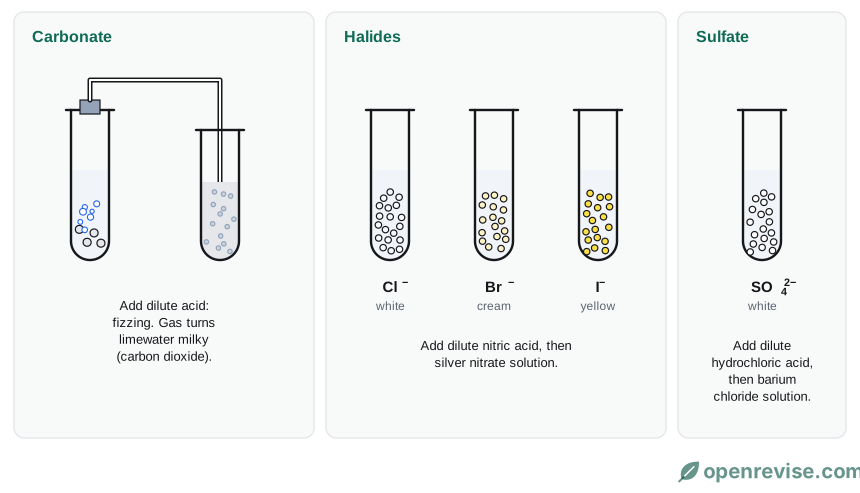
Add dilute acid (such as hydrochloric acid). A carbonate fizzes, giving off carbon dioxide, which turns limewater milky.
\mathrm{CO_3^{2-}} + 2\mathrm{H^+} → CO2 + H2O
Halide ions
Add dilute nitric acid, then silver nitrate solution. A precipitate of a silver halide forms:
| Halide ion | Precipitate | Colour |
|---|---|---|
| chloride, \mathrm{Cl^-} | silver chloride | white |
| bromide, \mathrm{Br^-} | silver bromide | cream |
| iodide, \mathrm{I^-} | silver iodide | yellow |
\mathrm{Ag^+}(aq) + \mathrm{Cl^-}(aq) → AgCl(s)
The nitric acid removes any carbonate ions, which would also form a precipitate with silver nitrate. Hydrochloric acid cannot be used, because it contains chloride ions.
Sulfate ions
Add dilute hydrochloric acid, then barium chloride solution. A white precipitate of barium sulfate forms.
\mathrm{Ba^{2+}}(aq) + \mathrm{SO_4^{2-}}(aq) → BaSO4(s)
The hydrochloric acid removes carbonate ions, which would otherwise form a white barium carbonate precipitate. Sulfuric acid cannot be used, because it contains sulfate ions.
| Ion | Add | Positive result |
|---|---|---|
| carbonate | dilute acid | fizzing; gas turns limewater milky |
| chloride, bromide, iodide | dilute nitric acid, then silver nitrate | white, cream, yellow precipitate |
| sulfate | dilute hydrochloric acid, then barium chloride | white precipitate |
Test yourself on this lesson
5 exam questions · 8 marks · with mark schemes and model answers
Found a mistake?