8.8 Instrumental methods and flame emission spectroscopy
The advantages of instrumental methods of analysis, how flame emission spectroscopy identifies metal ions from their line spectra, and how a calibration curve is used to find the concentration of an ion in a solution.
Separate only
AQA
Edexcel
OCR
2 min read
Instrumental methods
Key terms
- Instrumental method: a method of chemical analysis that uses a machine, such as flame emission spectroscopy.
- Calibration curve: a graph made using solutions of known concentration, used to find the concentration of an unknown sample.
Compared with chemical tests, instrumental methods are:
- accurate: they give reliable, precise results
- sensitive: they detect very small amounts of a substance
- rapid: results are produced quickly, and many samples can be tested automatically
Flame emission spectroscopy
- The sample is put into a flame.
- The light given out is passed through a spectroscope, which splits it into its wavelengths.
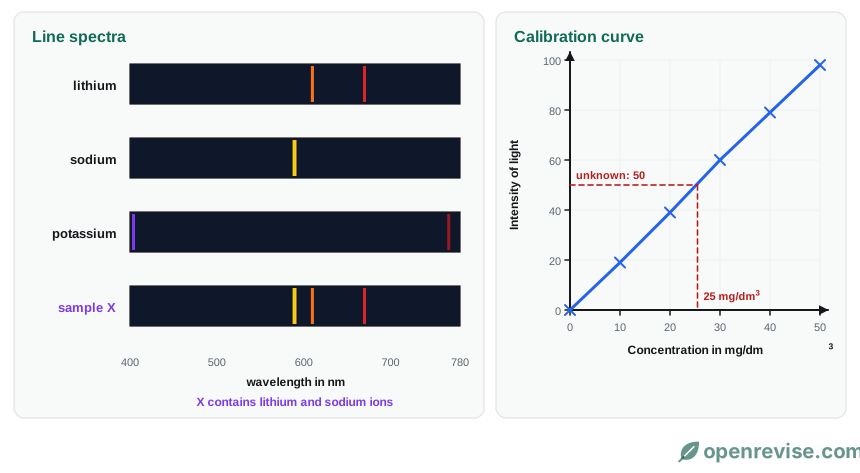
- The output is a line spectrum. Each metal ion produces its own unique pattern of lines, like a fingerprint.
Identifying ions
Compare the spectrum of the sample with reference spectra of known metal ions. If all the lines of a known ion appear in the sample, that ion is present. Unlike a flame test, this works for mixtures, because each ion's lines can be seen separately.
Finding the concentration
The intensity (brightness) of the lines depends on the concentration of the metal ion.
- Measure the intensity for several solutions of known concentration.
- Plot a calibration curve of intensity against concentration.
- Measure the intensity for the unknown solution, then read across to the line and down to find its concentration.
| Feature | Flame test | Flame emission spectroscopy |
|---|---|---|
| Identifies ions in mixtures | no, colours can be hidden | yes |
| Measures concentration | no | yes, with a calibration curve |
| Sensitivity | needs a fairly large amount | detects tiny amounts |
Test yourself on this lesson
5 exam questions · 9 marks · with mark schemes and model answers
Found a mistake?