8.7 Required practical: identifying ions
How to use flame tests, sodium hydroxide precipitates and tests for carbonate, halide and sulfate ions in order to identify the positive and negative ions in an unknown ionic compound.
Separate only
AQA
Edexcel
OCR
1 min read
The practical
This is AQA required practical 7 and Edexcel core practical 9.6C, and it is one of OCR's practical activities. You use the tests from the previous lessons to identify the ions in unknown salts.
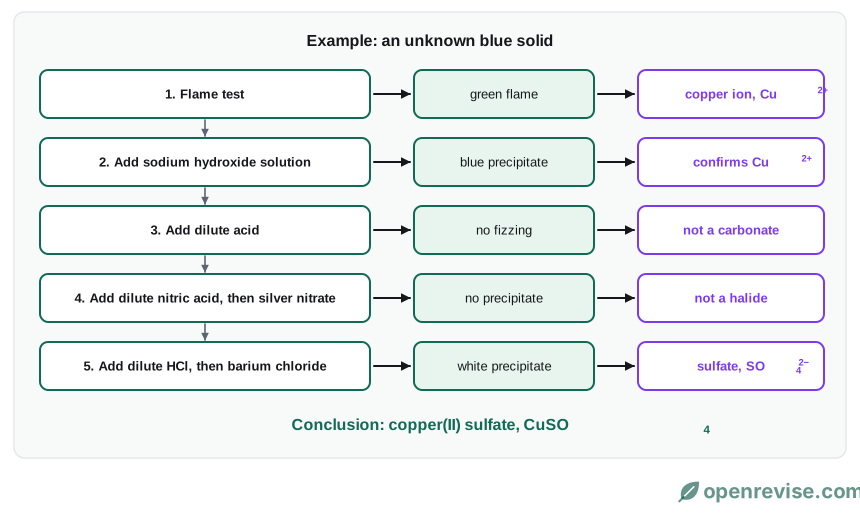
A logical order
Positive ion (metal or ammonium):
- Flame test (for \mathrm{Li^+}, \mathrm{Na^+}, \mathrm{K^+}, \mathrm{Ca^{2+}}, \mathrm{Cu^{2+}}).
- Dissolve the solid in water and add sodium hydroxide solution (for \mathrm{Al^{3+}}, \mathrm{Ca^{2+}}, \mathrm{Mg^{2+}}, \mathrm{Cu^{2+}}, \mathrm{Fe^{2+}}, \mathrm{Fe^{3+}}). Add excess if the precipitate is white.
Negative ion:
- Add dilute acid: fizzing and limewater turning milky shows carbonate.
- Add dilute nitric acid then silver nitrate: a white, cream or yellow precipitate shows chloride, bromide or iodide.
- Add dilute hydrochloric acid then barium chloride: a white precipitate shows sulfate.
Use a fresh sample of the solution for each test.
Worked example
| Test | Observation | Conclusion |
|---|---|---|
| flame test | orange-red | calcium ion |
| sodium hydroxide | white precipitate, does not dissolve in excess | confirms calcium (not aluminium) |
| nitric acid + silver nitrate | white precipitate | chloride ion |
The solid is calcium chloride, CaCl2.
Safety
- Silver nitrate stains skin; barium chloride is toxic; sodium hydroxide is corrosive. Wear eye protection and gloves where needed.
- Use only small amounts and dispose of solutions safely.
Test yourself on this lesson
5 exam questions · 8 marks · with mark schemes and model answers
Found a mistake?