8.3 Required practical: chromatography
How to separate coloured substances such as food colourings or inks by paper chromatography, why the method uses a pencil baseline, a lid and a solvent level below the line, and how to calculate Rf values from the results.
AQA
Edexcel
OCR
2 min read
The practical
This is AQA required practical 6 and Edexcel core practical 2.11, and it is one of OCR's practical activities. Edexcel's core practical also includes separating the solvent from an ink by simple distillation (see the distillation lesson).
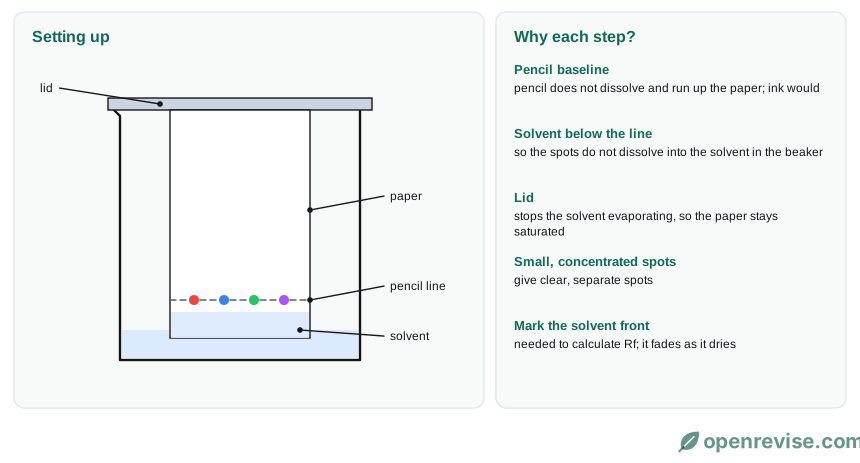
Method
- Draw a pencil line about 2 cm from the bottom of a piece of chromatography paper.
- Use a capillary tube to put a small spot of each colouring on the line, spaced apart. Let them dry and add more to make them concentrated.
- Pour solvent (such as water) into a beaker to a depth of about 1 cm, so the level is below the pencil line.
- Hang the paper in the beaker so the bottom dips into the solvent. Put on a lid.
- Leave the solvent to move up the paper. Remove the paper when the solvent is near the top.
- Mark the solvent front in pencil straight away, then leave the paper to dry.
- Measure the distance moved by each spot and by the solvent, and calculate the Rf values.
Results and conclusions
- A colouring with one spot may be pure.
- A colouring with several spots is a mixture.
- Spots with the same Rf in the same solvent are probably the same substance.
Possible errors
| Problem | Effect |
|---|---|
| baseline drawn in ink | the ink also separates and confuses the results |
| solvent above the baseline | spots dissolve into the solvent in the beaker |
| spots too large | they spread out and overlap |
| no lid | solvent evaporates from the paper; results less clear |
Safety
Some solvents are flammable or harmful: keep them away from flames, use small volumes and work in a ventilated room.
Test yourself on this lesson
5 exam questions · 6 marks · with mark schemes and model answers
Found a mistake?