8.2 Paper chromatography and Rf values
How paper chromatography separates mixtures using a stationary phase and a mobile phase, how to interpret a chromatogram to identify substances and tell pure from impure, and how to calculate Rf values.
AQA
Edexcel
OCR
1 min read
How chromatography works
Key terms
- Stationary phase: the part that does not move. In paper chromatography it is the paper.
- Mobile phase: the solvent, which moves through the paper carrying the substances.
- Rf value: the distance moved by a substance divided by the distance moved by the solvent.
Each substance in the mixture is shared between the stationary phase and the mobile phase. How far it travels depends on:
- how soluble it is in the solvent (more soluble → travels further)
- how strongly it is attracted to the paper (more attracted → travels less far)
So different substances move different distances and are separated.
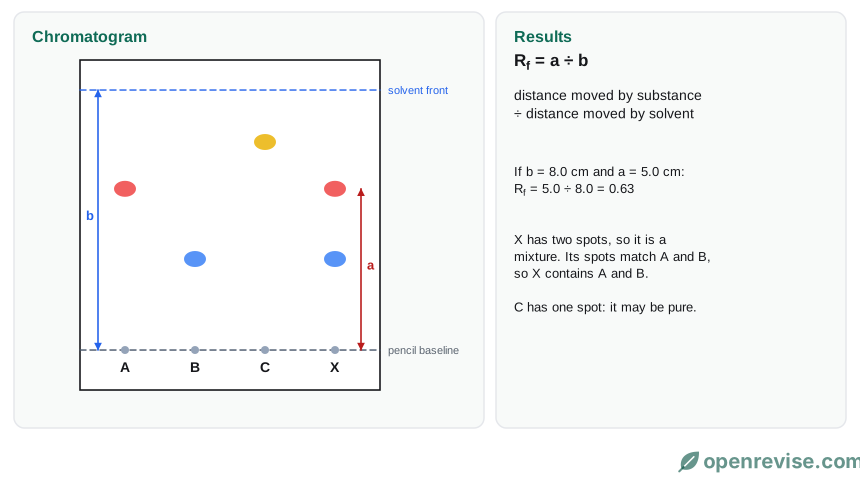
Reading a chromatogram
- A pure substance gives one spot (in every solvent tried).
- A mixture gives two or more spots.
- If a spot from an unknown is at the same height (same Rf, same solvent) as a known substance, it is probably the same substance.
Rf values
Rf = distance moved by substance / distance moved by solvent
Measure both distances from the baseline: to the centre of the spot, and to the solvent front.
Example: the solvent moved 8.0 cm and a spot moved 5.0 cm. Rf = 5.0 ÷ 8.0 = 0.63
- Rf values are always less than 1, because the substance cannot move further than the solvent.
- Rf has no units.
- The Rf value of a substance depends on the solvent used, so you must compare results using the same solvent.
Test yourself on this lesson
5 exam questions · 7 marks · with mark schemes and model answers
Found a mistake?