4.17 Core practical: electrolysis of copper sulfate
Electrolysing copper sulfate solution with inert and then copper electrodes, measuring the change in mass of each copper electrode at different currents, and how the same process is used to purify copper.
Edexcel
OCR
2 min read
The practical
This is Edexcel core practical 3.31, and it is also one of OCR's practical activities on electrolysis.
With inert (carbon) electrodes
- Cathode: copper is deposited (\mathrm{Cu^{2+}} + 2\mathrm{e^-} → Cu).
- Anode: bubbles of oxygen form, because there are no halide ions.
- The blue colour of the solution fades as copper ions are removed.
With copper electrodes
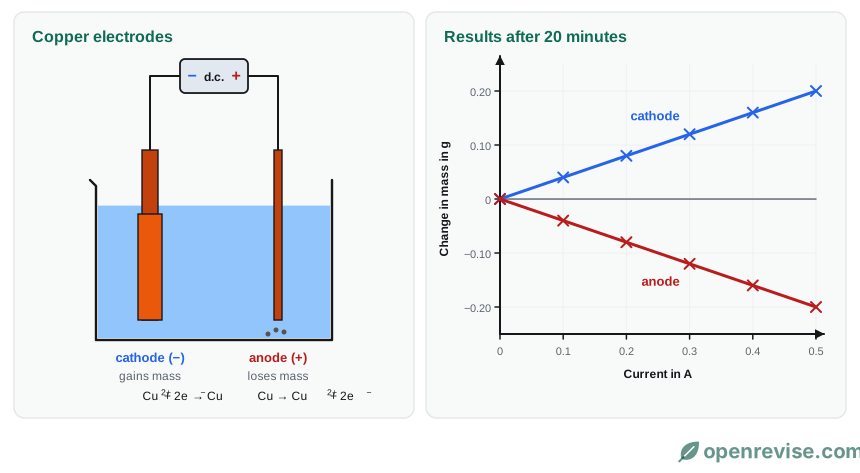
- Anode: copper atoms lose electrons and go into solution as ions: Cu → \mathrm{Cu^{2+}} + 2\mathrm{e^-}. The anode loses mass.
- Cathode: copper ions gain electrons and copper is deposited: \mathrm{Cu^{2+}} + 2\mathrm{e^-} → Cu. The cathode gains mass.
- The solution stays blue, because copper ions are added at the anode as fast as they are removed at the cathode.
Method
- Clean two copper electrodes with emery paper, then rinse, dry and weigh each one.
- Set up the circuit with the electrodes in copper sulfate solution, an ammeter and a variable resistor to set the current.
- Pass a current of, for example, 0.2 A for 20 minutes.
- Remove the electrodes, rinse with distilled water, then propanone, and dry them.
- Reweigh each electrode and work out the change in mass.
- Repeat with fresh electrodes at different currents.
Results
- The cathode gains exactly as much mass as the anode loses.
- The change in mass is directly proportional to the current (and to the time).
Purifying copper
The same process purifies copper for electrical wiring:
- the anode is a block of impure copper
- the cathode is a thin sheet of pure copper
- copper dissolves from the anode and is deposited on the cathode as pure copper
- impurities fall to the bottom as a sludge (which can contain valuable metals such as silver and gold)
Test yourself on this lesson
5 exam questions · 10 marks · with mark schemes and model answers
Found a mistake?