4.16 Required practical: electrolysis of aqueous solutions
How to electrolyse aqueous solutions with inert electrodes, collect and test the gases produced, record observations at each electrode and test a hypothesis about the products.
AQA
OCR
1 min read
The practical
This is AQA required practical 3, and it is one of OCR's practical activities on electrolysis. You test the hypothesis that the products depend on the reactivity of the metal and on whether halide ions are present.
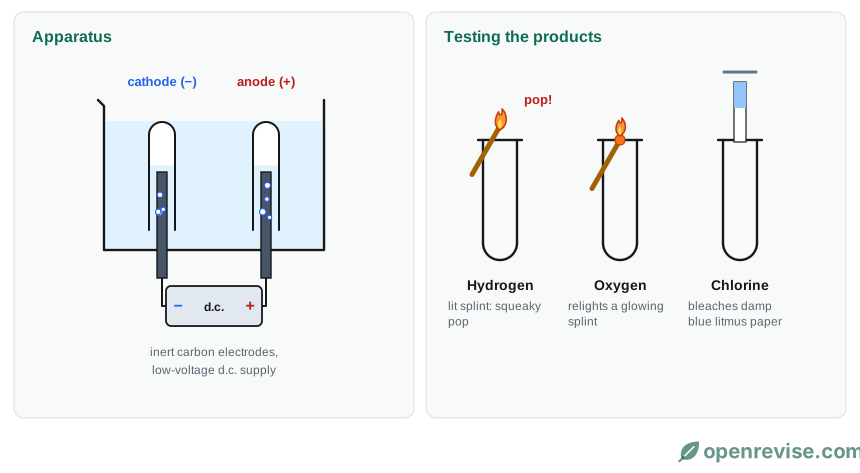
Method
- Pour about 50 cm3 of the solution (for example copper chloride) into a beaker.
- Put a lid on the beaker with two inert carbon electrodes through it. The electrodes must not touch.
- Fill two small test tubes with the solution and turn them upside down over the electrodes to collect any gas.
- Connect the electrodes to a low-voltage d.c. supply (about 4 V) and switch on.
- Observe each electrode. Look for bubbles or a coating of metal.
- Test any gas collected (see below), then switch off.
- Repeat with other solutions, such as sodium chloride, copper sulfate and sodium sulfate.
Testing the products
| Gas | Test | Positive result |
|---|---|---|
| Hydrogen | lit splint | squeaky pop |
| Oxygen | glowing splint | relights |
| Chlorine | damp blue litmus paper | turns red, then bleached white |
A pink-brown coating on the cathode shows that copper has formed.
Typical results
| Solution | Cathode | Anode |
|---|---|---|
| copper chloride | pink-brown copper coating | bubbles; bleaches litmus (chlorine) |
| sodium chloride | bubbles; squeaky pop (hydrogen) | bubbles; bleaches litmus (chlorine) |
| copper sulfate | pink-brown copper coating | bubbles; relights glowing splint (oxygen) |
Safety
- Chlorine is toxic: use small amounts, work in a well-ventilated room and switch off as soon as the chlorine has been tested.
- Wear eye protection. Copper salts are harmful.
- Use a low voltage supply.
Test yourself on this lesson
5 exam questions · 7 marks · with mark schemes and model answers
Found a mistake?