4.12 Electrolysis of molten ionic compounds
What electrolysis is, why an ionic compound must be molten or dissolved, how positive ions move to the cathode and negative ions to the anode, and how to predict the products of electrolysing a molten binary ionic compound.
What is electrolysis?
Key terms
- Electrolysis: using electricity from a direct current (d.c.) supply to break down an ionic compound.
- Electrolyte: an ionic compound that is molten or dissolved in water, so its ions are free to move.
- Cathode: the negative electrode. Anode: the positive electrode.
An ionic compound must be molten or dissolved to be electrolysed. In a solid, the ions are fixed in the lattice and cannot move.
Movement of ions
- Positive ions (cations, usually metal ions) are attracted to the negative cathode.
- Negative ions (anions, non-metal ions) are attracted to the positive anode.
At the electrodes, the ions gain or lose electrons and are discharged as elements.
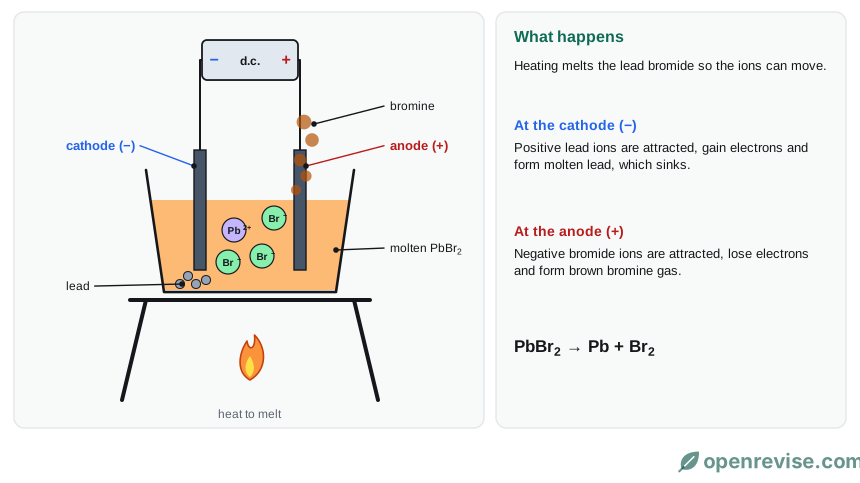
Molten lead bromide
- At the cathode: \mathrm{Pb^{2+}} ions gain electrons → lead (a silvery liquid that sinks).
- At the anode: \mathrm{Br^-} ions lose electrons → bromine (a brown gas).
Overall: PbBr2(l) → Pb(l) + Br2(g)
The electrodes are usually inert, such as graphite (carbon) or platinum, so they do not react with the products. Bromine is toxic, so this is done in a fume cupboard.
Predicting products of molten binary compounds
A binary ionic compound contains just two elements. When it is molten:
- the metal forms at the cathode
- the non-metal forms at the anode
| Electrolyte | At the cathode | At the anode |
|---|---|---|
| lead bromide, PbBr2 | lead | bromine |
| sodium chloride, NaCl | sodium | chlorine |
| zinc chloride, ZnCl2 | zinc | chlorine |
| aluminium oxide, Al2O3 | aluminium | oxygen |
Test yourself on this lesson
5 exam questions · 9 marks · with mark schemes and model answers
Found a mistake?