4.11 Titrations
How to carry out an accurate acid-alkali titration using a pipette, burette and indicator, how to read a burette, and how to identify concordant titres and calculate a mean titre.
AQA
Edexcel
OCR
2 min read
What a titration does
Key terms
- Titration: a method used to find the exact volume of one solution that reacts with a known volume of another.
- End point: the point at which the indicator changes colour, showing the reaction is just complete.
- Titre: the volume of solution added from the burette to reach the end point.
This is AQA required practical 2 and Edexcel core practical 5.9C, and it is one of OCR's practical activities. The calculations are in the lesson on concentrations in mol/dm3.
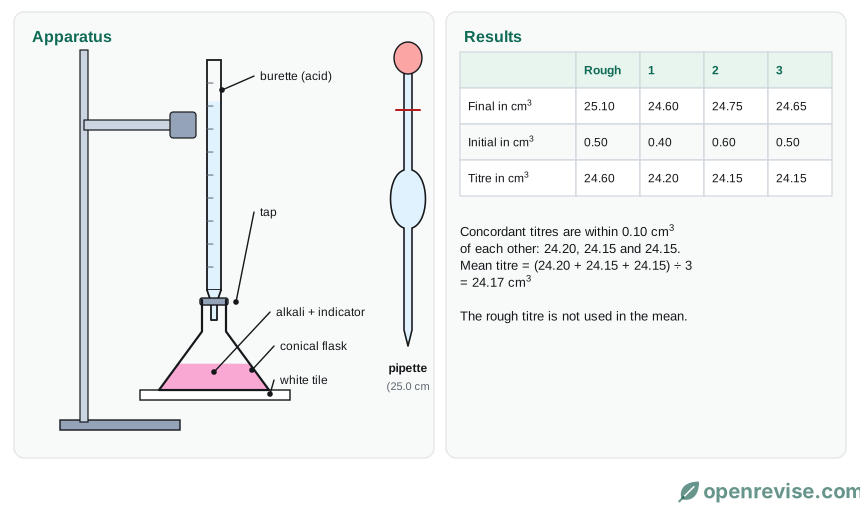
Method
- Rinse a pipette with the alkali, then use a pipette filler to transfer exactly 25.0 cm3 of alkali into a conical flask.
- Add a few drops of an indicator such as phenolphthalein or methyl orange.
- Rinse a burette with the acid, then fill it. Record the initial reading at eye level, from the bottom of the meniscus.
- Stand the flask on a white tile so the colour change is easy to see.
- Add acid from the burette, swirling the flask. Near the end point, add the acid drop by drop.
- Stop when the indicator just changes colour permanently. Record the final reading.
- Do a quick rough titration first, then repeat accurately until you have concordant results (titres within 0.10 cm3 of each other).
Why each piece of equipment
| Equipment | Reason |
|---|---|
| Pipette | measures a fixed volume very accurately |
| Burette | measures the variable volume added, to 0.05 cm3 |
| White tile | makes the colour change easy to see |
| Single indicator | sudden, clear colour change at the end point |
Universal indicator is not used, because it changes colour gradually through many colours, so the end point is not clear.
Calculating the mean titre
Ignore the rough titre. Average only the concordant titres.
Test yourself on this lesson
5 exam questions · 7 marks · with mark schemes and model answers
Found a mistake?