4.15 Half equations at the electrodes
Writing and balancing half equations for the reactions at the cathode and anode during electrolysis, and explaining that reduction happens at the cathode and oxidation at the anode.
Higher only
AQA
Edexcel
OCR
1 min read
Electrons at the electrodes
Key terms
- Half equation: an equation showing the electrons gained or lost by one substance at an electrode.
- At the cathode (−), positive ions gain electrons. This is reduction.
- At the anode (+), negative ions lose electrons. This is oxidation.
Remember OIL RIG: oxidation is loss, reduction is gain.
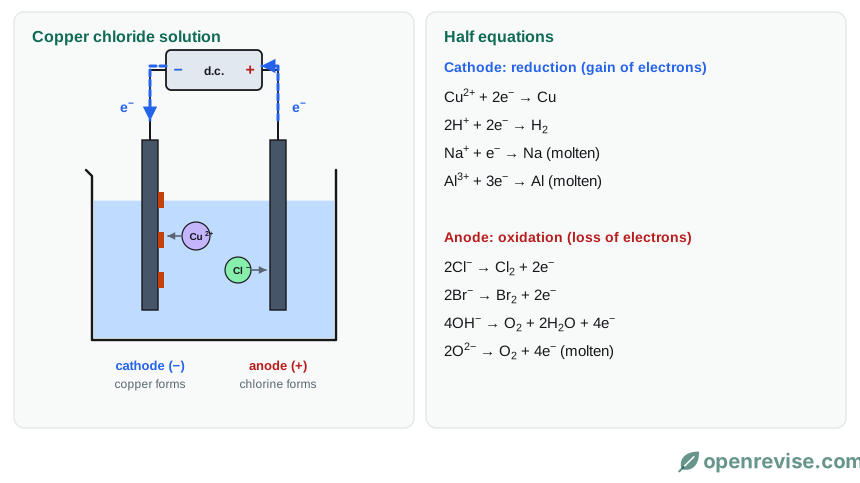
Writing a half equation
- Write the ion on one side and the product on the other.
- Balance the atoms (for example, two chloride ions make one Cl2 molecule).
- Add electrons so that the charges balance on both sides.
Example: chlorine at the anode
- \mathrm{Cl^-} → Cl2
- balance atoms: 2\mathrm{Cl^-} → Cl2
- charges: left 2−, right 0, so add 2 electrons on the right: 2\mathrm{Cl^-} → Cl2 + 2\mathrm{e^-}
Example: copper at the cathode
- \mathrm{Cu^{2+}} → Cu: left 2+, right 0, so add 2 electrons on the left: \mathrm{Cu^{2+}} + 2\mathrm{e^-} → Cu
Common half equations
| Electrode | Half equation | Product |
|---|---|---|
| Cathode | \mathrm{Cu^{2+}} + 2\mathrm{e^-} → Cu | copper |
| Cathode | 2\mathrm{H^+} + 2\mathrm{e^-} → H2 | hydrogen |
| Cathode | \mathrm{Al^{3+}} + 3\mathrm{e^-} → Al | aluminium (molten) |
| Anode | 2\mathrm{Cl^-} → Cl2 + 2\mathrm{e^-} | chlorine |
| Anode | 4\mathrm{OH^-} → O2 + 2H2O + 4\mathrm{e^-} | oxygen (from solutions) |
| Anode | 2\mathrm{O^{2-}} → O2 + 4\mathrm{e^-} | oxygen (molten oxides) |
Test yourself on this lesson
5 exam questions · 8 marks · with mark schemes and model answers
Found a mistake?