4.7 Required practical: making a soluble salt
How to make pure, dry crystals of a soluble salt such as copper sulfate from an insoluble base and an acid: warming the acid, adding excess base, filtering, evaporating and crystallising, and why each step is done.
AQA
Edexcel
OCR
2 min read
Making copper sulfate crystals
This is AQA required practical 1 and Edexcel core practical 3.17, and it is one of OCR's practical activities.
copper oxide + sulfuric acid → copper sulfate + water
CuO(s) + H2SO4(aq) → CuSO4(aq) + H2O(l)
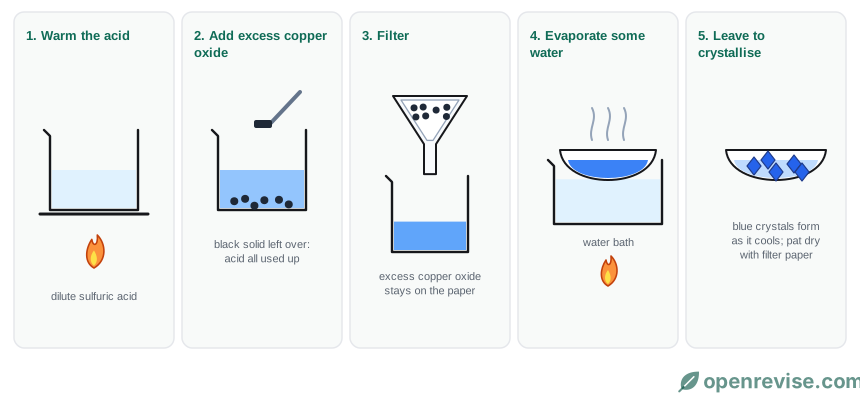
Method
- Measure about 40 cm3 of dilute sulfuric acid into a beaker and warm it gently with a Bunsen burner. Warming makes the reaction faster. Do not boil it.
- Add copper oxide a spatula at a time, stirring, until some black solid is left over (it is in excess). The solution turns blue.
- Filter the mixture to remove the excess copper oxide. Collect the blue filtrate.
- Pour the filtrate into an evaporating basin and heat it over a water bath to evaporate some of the water, until crystals start to form at the edge.
- Leave the solution to cool and crystallise. Pat the crystals dry with filter paper.
Why each step matters
| Step | Reason |
|---|---|
| Warm the acid | speeds up the reaction |
| Add excess copper oxide | makes sure all the acid reacts, so no acid is left in the salt |
| Filter | removes the unreacted copper oxide, which is insoluble |
| Water bath | heats gently and evenly, so the solution does not spit or decompose |
| Do not boil dry | slow crystallisation gives larger, purer crystals of the hydrated salt |
The same method can be used with a metal carbonate (you will see fizzing until the carbonate is in excess) or a reactive metal such as zinc.
Safety
- Wear eye protection: hot acid and spitting solutions are hazardous.
- Copper sulfate is harmful, so avoid skin contact and wash your hands.
Test yourself on this lesson
5 exam questions · 8 marks · with mark schemes and model answers
Found a mistake?