4.8 Core practical: pH change in neutralisation
Edexcel core practical: adding calcium hydroxide a little at a time to dilute hydrochloric acid, measuring the pH after each addition, and plotting and explaining the pH curve.
Edexcel
2 min read
The investigation
This is Edexcel core practical 3.6: investigate the change in pH when powdered calcium hydroxide (or calcium oxide) is added to a fixed volume of dilute hydrochloric acid.
Ca(OH)2 + 2HCl → CaCl2 + 2H2O
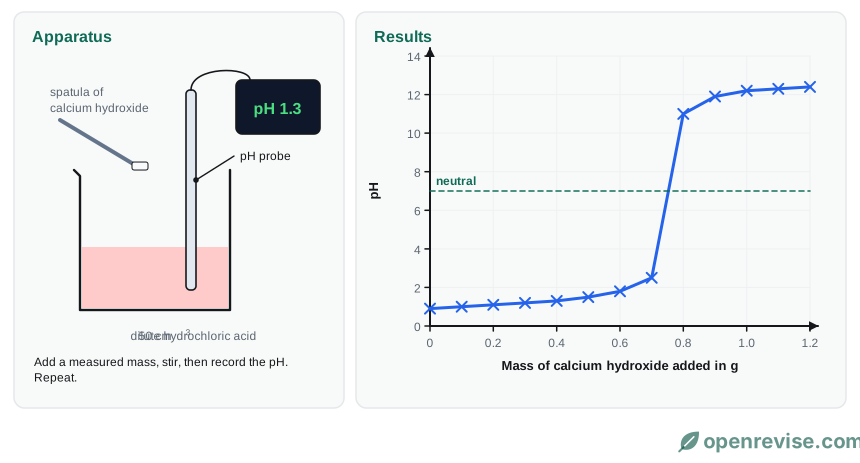
Method
- Measure 50 cm3 of dilute hydrochloric acid into a beaker using a measuring cylinder.
- Measure the pH with a pH probe (or a drop on universal indicator paper, compared with the colour chart).
- Weigh about 0.1 g of calcium hydroxide powder and add it to the acid. Stir.
- Measure and record the pH.
- Repeat steps 3 and 4 until the pH stops changing.
- Plot a graph of pH (y-axis) against total mass of calcium hydroxide added (x-axis).
Variables
- Independent: mass of calcium hydroxide added
- Dependent: pH of the mixture
- Control: volume and concentration of the acid, temperature, stirring
Explaining the results
- At first, the pH is low (about 1) because there is excess acid. It rises slowly as the acid is used up.
- Near the neutralisation point, a small amount of calcium hydroxide causes a large, sudden rise in pH, through pH 7.
- After that, calcium hydroxide is in excess and the pH levels off at about 12. Calcium hydroxide is only slightly soluble, so the pH does not go higher.
| Method | Advantage | Disadvantage |
|---|---|---|
| Universal indicator paper | cheap and quick | only approximate; colour is judged by eye |
| pH probe | accurate, precise, numerical reading | must be calibrated and rinsed between readings |
Safety
Wear eye protection. Calcium hydroxide is an irritant, and hydrochloric acid is corrosive at higher concentrations.
Test yourself on this lesson
5 exam questions · 8 marks · with mark schemes and model answers
Found a mistake?