9.2 Greenhouse gases
How greenhouse gases such as carbon dioxide, methane and water vapour keep the Earth warm by absorbing long-wavelength radiation, and the human activities that increase the amounts of these gases in the atmosphere.
AQA
Edexcel
OCR
1 min read
The greenhouse effect
Key terms
- Greenhouse gas: a gas in the atmosphere that absorbs long-wavelength (infrared) radiation and re-emits it, keeping the Earth warm. Examples are carbon dioxide, methane and water vapour.
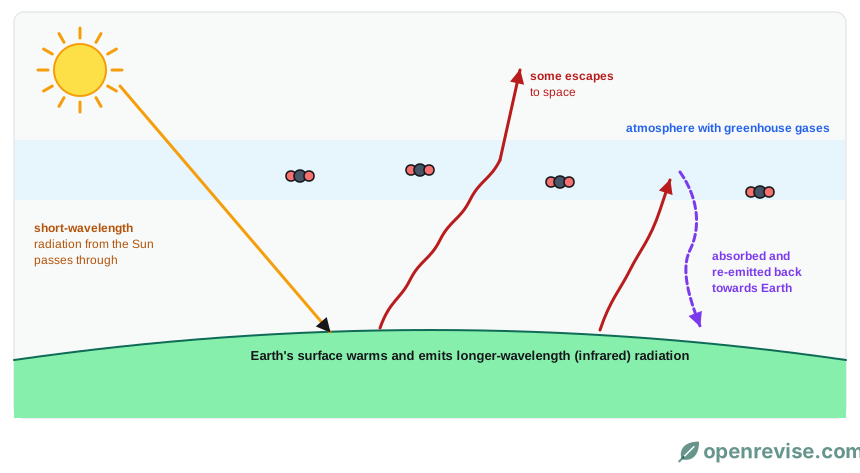
- Short-wavelength radiation from the Sun passes through the atmosphere.
- It is absorbed by the Earth's surface, which warms up.
- The Earth emits longer-wavelength (infrared) radiation.
- Some of this escapes to space, but some is absorbed by greenhouse gases and re-emitted in all directions, including back towards the Earth.
- This keeps the Earth warm enough to support life. Without greenhouse gases, the average temperature would be about −18 °C.
The problem is that increasing the amounts of greenhouse gases traps more energy, so the temperature rises.
Human activities
| Activity | Gas added |
|---|---|
| burning fossil fuels (power stations, vehicles, heating) | carbon dioxide |
| deforestation (fewer trees to absorb CO2; often burned) | carbon dioxide |
| cattle and other livestock farming (digestion) | methane |
| rice paddy fields | methane |
| decay of waste in landfill sites | methane |
The world's population is growing, so more energy and food are needed, adding more greenhouse gases.
Comparing gases
- Carbon dioxide is the main greenhouse gas released by humans.
- Methane is a much more powerful greenhouse gas than carbon dioxide, but there is far less of it.
- Water vapour is the most abundant greenhouse gas, but humans do not change its amount directly.
Test yourself on this lesson
5 exam questions · 10 marks · with mark schemes and model answers
Found a mistake?