9.3 Climate change and the carbon footprint
The evidence linking human activities to climate change, why climate models are uncertain, the possible effects of a warmer climate, what a carbon footprint is, and how it can be reduced along with the problems in doing so.
Evidence for climate change
Key terms
- Climate change: long-term changes to the Earth's climate, including global warming.
- Carbon footprint: the total amount of carbon dioxide and other greenhouse gases emitted over the full life cycle of a product, service or event.
Since the Industrial Revolution, the concentration of carbon dioxide in the atmosphere has risen from about 285 to over 410 parts per million, mostly from burning fossil fuels. Over the same time, the average global temperature has risen by about 1 °C.
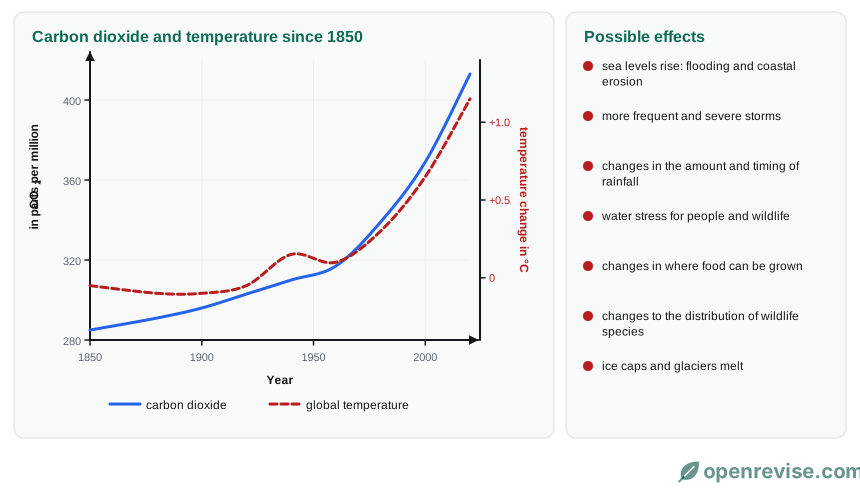
Based on peer-reviewed evidence, most scientists agree that human activities are very likely to be causing the temperature to rise.
Uncertainty
The climate is very complex, so it is hard to model. Models are simplified, and predictions depend on assumptions about future emissions. This means:
- predictions of future temperature rises give a range of values
- the media may present simplified or biased versions of the evidence
Possible effects of a warmer climate
- sea level rise, causing flooding and coastal erosion
- more frequent and severe storms
- changes in the amount, timing and distribution of rainfall
- temperature and water stress for humans and wildlife
- changes in the food-producing capacity of some regions
- changes in the distribution of wildlife species
Reducing the carbon footprint
- using renewable energy (wind, solar) and nuclear power instead of fossil fuels
- energy conservation: insulation, efficient appliances, using less energy
- carbon capture and storage: storing CO2 underground
- carbon taxes and licences to make emissions more expensive
- carbon offsetting, for example by planting trees
- using plants as biofuels
Problems in reducing it
- scientific disagreement about causes and effects
- lack of public information and education
- people are unwilling to change their lifestyle
- economic considerations: changes can be expensive, and countries worry about their economies
- it needs international cooperation, which is hard to agree
Test yourself on this lesson
5 exam questions · 10 marks · with mark schemes and model answers
Found a mistake?