5.2 Required practical: temperature changes
How to investigate the temperature change in a reaction using a polystyrene cup, how the volume of alkali added affects the highest temperature in a neutralisation, and how to reduce energy losses.
AQA
Edexcel
OCR
2 min read
The practical
This is AQA required practical 4. Edexcel (7.9) and OCR use the same method to measure temperature changes when salts dissolve and in neutralisation, displacement and precipitation reactions.
A typical investigation: how does the volume of sodium hydroxide solution added to hydrochloric acid affect the temperature change?
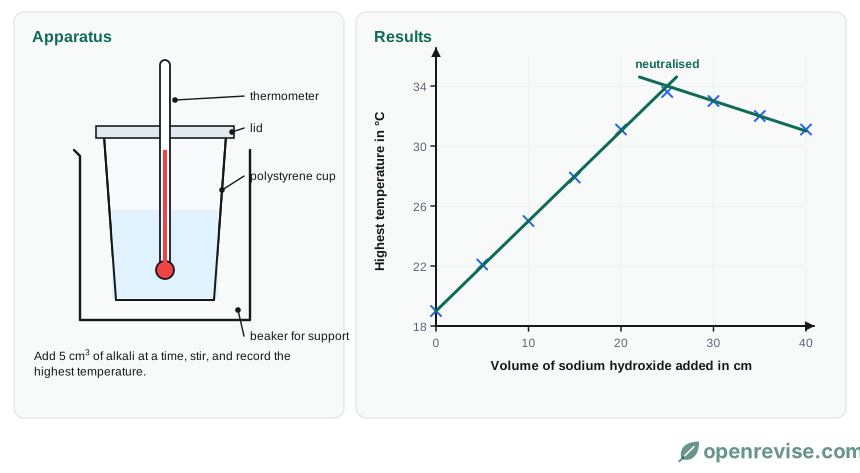
Method
- Measure 30 cm3 of dilute hydrochloric acid into a polystyrene cup standing in a beaker (so it does not fall over).
- Measure the starting temperature of the acid.
- Add 5 cm3 of sodium hydroxide solution, put on the lid, stir and record the highest temperature.
- Repeat, adding 5 cm3 at a time, up to 40 cm3.
- Repeat the whole experiment and calculate mean temperatures.
- Plot highest temperature against volume of alkali added, and draw two lines of best fit.
Variables
- Independent: volume of sodium hydroxide added
- Dependent: highest temperature reached
- Control: volume and concentration of acid, concentration of alkali, starting temperature
Explaining the results
- At first the temperature rises with each addition, because more neutralisation happens and more energy is released.
- The highest temperature is reached when the acid is exactly neutralised: where the two lines of best fit cross.
- After that, adding more alkali does not react. It is cooler than the mixture, so it lowers the temperature slightly.
Reducing energy losses
| Feature | Reason |
|---|---|
| Polystyrene cup | a good thermal insulator, so less energy is lost to the surroundings |
| Lid | reduces energy lost by evaporation and convection |
| Stirring | mixes the reactants so the temperature is the same throughout |
| Reading the highest temperature | the true maximum before the mixture cools |
Test yourself on this lesson
5 exam questions · 9 marks · with mark schemes and model answers
Found a mistake?