5.3 Reaction profiles and activation energy
How to draw and interpret reaction profiles for exothermic and endothermic reactions, what activation energy is, and why breaking bonds is endothermic and making bonds is exothermic.
AQA
Edexcel
OCR
1 min read
Reaction profiles
Key terms
- Reaction profile: a diagram showing the energy of the reactants and products, and the activation energy, as a reaction happens.
- Activation energy: the minimum amount of energy that particles must have to react when they collide.
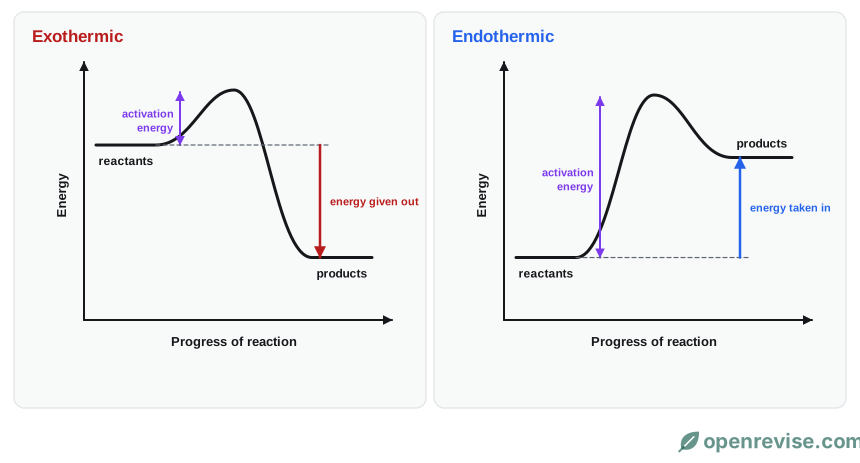
| Feature | Exothermic | Endothermic |
|---|---|---|
| Products compared with reactants | lower in energy | higher in energy |
| Overall energy change | given out to the surroundings | taken in from the surroundings |
| Temperature of surroundings | rises | falls |
Drawing a reaction profile
- Draw axes: energy (y-axis) against progress of reaction (x-axis).
- Draw a horizontal line for the reactants and another for the products (lower for exothermic, higher for endothermic).
- Join them with a curve that rises above the reactants: the hump.
- Draw an arrow from the reactants up to the top of the hump: the activation energy.
- Draw an arrow from the reactants to the products: the overall energy change.
Activation energy
Even exothermic reactions need some energy to start: a match needs to be struck, and a fuel needs a spark. This energy is needed to start breaking bonds in the reactants. A catalyst provides a different route with a lower activation energy.
Breaking and making bonds
- Breaking bonds needs energy: it is endothermic.
- Making bonds releases energy: it is exothermic.
In an exothermic reaction, more energy is released making new bonds than is needed to break the old ones. In an endothermic reaction, more energy is needed to break bonds than is released making them.
Test yourself on this lesson
5 exam questions · 10 marks · with mark schemes and model answers
Found a mistake?