3.5 The mole and Avogadro's constant
What a mole is, the Avogadro constant, and how to convert between mass, moles and numbers of particles using Mr and 6.02 × 10^23.
Higher only
AQA
Edexcel
OCR
1 min read
The mole
Key terms
- Mole: the amount of a substance that contains 6.02 × 10²³ particles (atoms, molecules, ions or electrons). Its symbol is mol.
- Avogadro constant: the number of particles in one mole, 6.02 × 10²³ per mole.
Chemists count particles in moles, because atoms are far too small to count one by one.
The mass of one mole of a substance, in grams, is equal to its relative formula mass (M_\mathrm{r}) (or A_\mathrm{r} for an element).
- 1 mole of carbon atoms (A_\mathrm{r} = 12) has a mass of 12 g.
- 1 mole of water molecules (M_\mathrm{r} = 18) has a mass of 18 g.
Both contain 6.02 × 10²³ particles.
Mass and moles
moles = mass (g) ÷ M_r
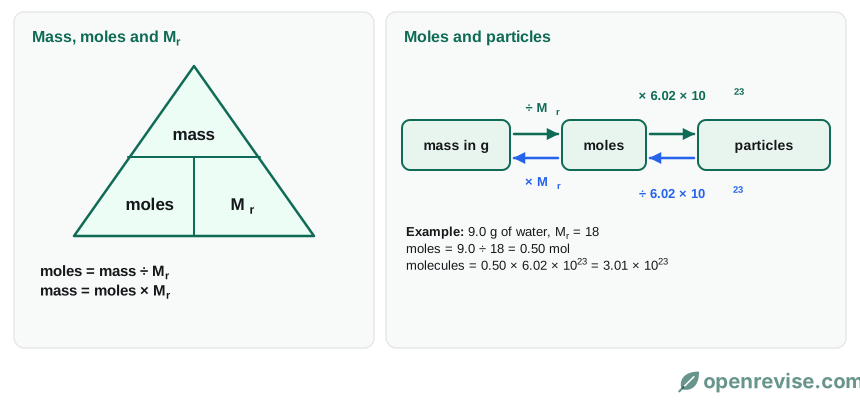
Examples:
- Moles in 88 g of CO2 (M_\mathrm{r} = 44): 88 ÷ 44 = 2.0 mol
- Mass of 0.25 mol of CaCO3 (M_\mathrm{r} = 100): 0.25 × 100 = 25 g
Moles and particles
number of particles = moles × 6.02 × 10^23
Example: 0.5 mol of water contains 0.5 × 6.02 × 1023 = 3.01 × 10²³ molecules.
Each water molecule contains 3 atoms, so 0.5 mol of water contains 3 × 3.01 × 1023 = 9.03 × 10²³ atoms.
Test yourself on this lesson
5 exam questions · 7 marks · with mark schemes and model answers
Found a mistake?