3.6 Reacting masses from equations
How to use a balanced equation and relative formula masses to calculate the mass of a reactant or product, and how to work out the balanced equation from the masses that react.
Using the balanced equation
A balanced equation tells you the ratio in which substances react. You can use it to calculate the mass of a product from the mass of a reactant (or the other way round).
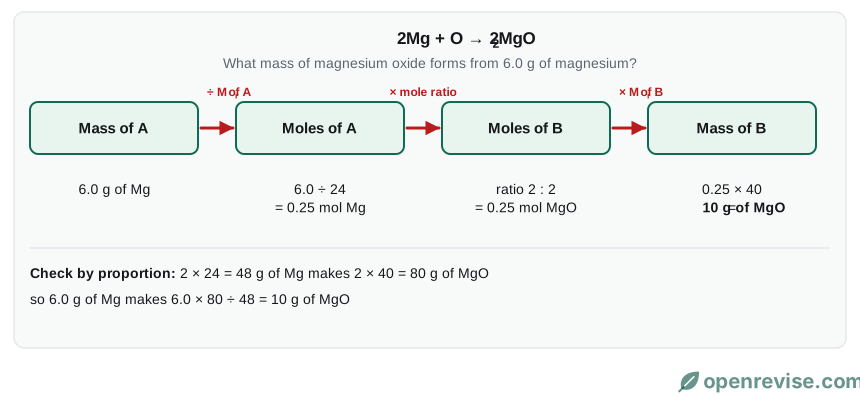
The mole method
- Moles of the substance you know: moles = mass ÷ M_\mathrm{r}
- Use the ratio from the balanced equation to find the moles of the substance you want.
- Mass of the substance you want: mass = moles × M_\mathrm{r}
Example: what mass of carbon dioxide is made when 25 g of calcium carbonate is heated?
CaCO3 → CaO + CO2 (M_\mathrm{r}: CaCO3 = 100, CO2 = 44)
- moles of CaCO3 = 25 ÷ 100 = 0.25 mol
- ratio 1 : 1, so 0.25 mol of CO2
- mass of CO2 = 0.25 × 44 = 11 g
The proportion method
Use the M_\mathrm{r} values and the numbers in the equation as reacting masses, then scale.
Example: 2Mg + O2 → 2MgO. 48 g of Mg makes 80 g of MgO, so 6.0 g of Mg makes 6.0 × 80 ÷ 48 = 10 g.
Working out the equation from masses
You can work backwards: convert each mass to moles, then find the simplest whole-number ratio.
Example: 4.8 g of Mg reacts with 3.2 g of O2 to make 8.0 g of MgO.
- Mg: 4.8 ÷ 24 = 0.2 mol; O2: 3.2 ÷ 32 = 0.1 mol; MgO: 8.0 ÷ 40 = 0.2 mol
- divide by 0.1 → 2 : 1 : 2, so 2Mg + O2 → 2MgO
Test yourself on this lesson
5 exam questions · 14 marks · with mark schemes and model answers
Found a mistake?