10.11 NPK fertilisers
Why plants need nitrogen, phosphorus and potassium, how ammonium nitrate, ammonium sulfate and phosphate fertilisers are made from raw materials, and how the laboratory preparation of ammonium sulfate compares with industrial production.
Why fertilisers?
Key terms
- NPK fertiliser: a formulation containing compounds of nitrogen, phosphorus and potassium in suitable proportions to improve plant growth.
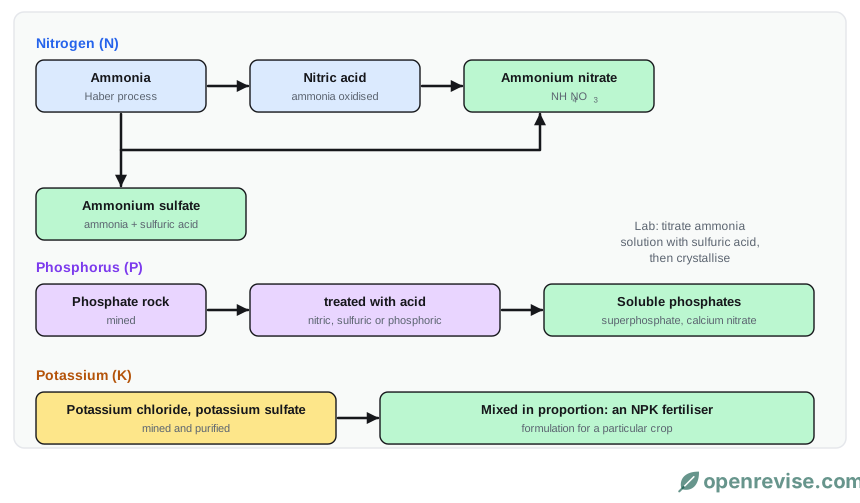
Plants need the elements nitrogen (N), phosphorus (P) and potassium (K) to grow. Fertilisers replace these elements in the soil and increase crop yields. The compounds must be soluble so that plants can absorb them through their roots.
Nitrogen compounds
- Ammonia is made by the Haber process.
- Some ammonia is oxidised to make nitric acid.
- ammonia + nitric acid → ammonium nitrate: NH3 + HNO3 → NH4NO3
- ammonia + sulfuric acid → ammonium sulfate: 2NH3 + H2SO4 → (NH4)2SO4
Phosphorus compounds
Phosphate rock is mined, but it is insoluble. It is treated with acids to make soluble salts:
- with nitric acid: phosphoric acid and calcium nitrate
- with sulfuric acid: single superphosphate (calcium phosphate and calcium sulfate)
- with phosphoric acid: triple superphosphate (calcium phosphate)
Potassium compounds
Potassium chloride and potassium sulfate are obtained by mining and can be used directly.
Making ammonium sulfate: lab compared with industry
| Feature | Laboratory | Industry |
|---|---|---|
| Scale | small (grams) | very large (tonnes) |
| Process | batch: titration, then crystallisation | continuous |
| Raw materials | bought solutions of ammonia and sulfuric acid | made on site from natural gas, air, sulfur and water |
| Number of stages | few | several (making ammonia and sulfuric acid first) |
Lab method: titrate dilute ammonia solution with dilute sulfuric acid using methyl orange to find the volumes; repeat without the indicator; evaporate some water and leave to crystallise.
Test yourself on this lesson
5 exam questions · 9 marks · with mark schemes and model answers
Found a mistake?