10.10 The Haber process
How ammonia is made by the Haber process from nitrogen and hydrogen, the conditions used (450 °C, 200 atmospheres, iron catalyst), recycling of unreacted gases, and (Higher) why the conditions are a compromise between rate, yield and cost.
AQA
Edexcel
OCR
1 min read
Making ammonia
Key terms
- Haber process: the industrial process that makes ammonia from nitrogen and hydrogen.
Ammonia is used to make fertilisers, as well as nitric acid and explosives.
N2(g) + 3H2(g) ⇌ 2NH3(g)
- Nitrogen comes from the air.
- Hydrogen comes from natural gas (methane) reacting with steam.
The reaction is reversible, and the forward reaction is exothermic.
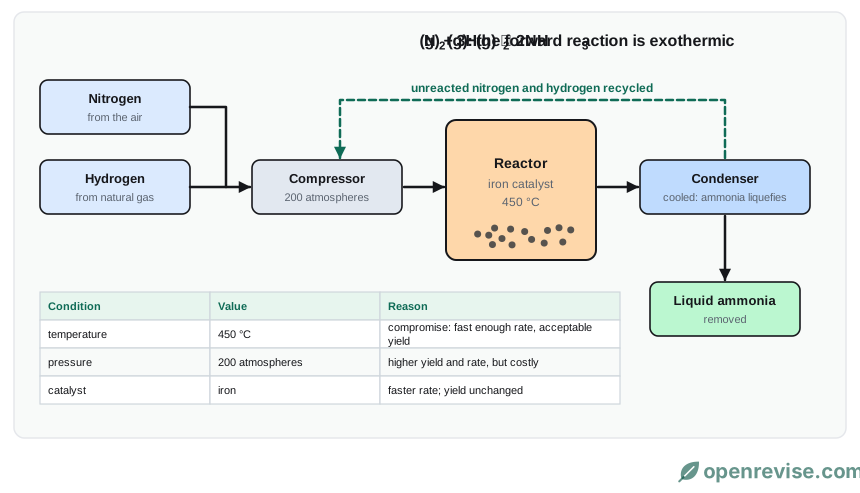
The process
- The purified gases are compressed to about 200 atmospheres.
- They pass over an iron catalyst at about 450 °C.
- Only some of the gases react. The mixture is cooled, so the ammonia liquefies and is removed.
- The unreacted nitrogen and hydrogen are recycled back into the reactor, so none is wasted.
Choosing the conditions (Higher)
Temperature:
- The forward reaction is exothermic, so a lower temperature gives a higher yield of ammonia.
- But a lower temperature makes the reaction too slow.
- 450 °C is a compromise between a reasonable yield and a fast enough rate.
Pressure:
- There are 4 molecules of gas on the left and 2 on the right. A higher pressure shifts the equilibrium to the right, giving a higher yield, and also increases the rate.
- But very high pressures need expensive, strong equipment and more energy, and are more dangerous.
- 200 atmospheres is a compromise between yield and cost and safety.
Catalyst:
- Iron speeds up both the forward and backward reactions, so equilibrium is reached faster.
- It does not change the yield.
Test yourself on this lesson
6 exam questions · 12 marks · with mark schemes and model answers
Found a mistake?