10.8 Alloys
Why alloys are harder than pure metals, the composition and uses of bronze, brass, gold alloys, steels and aluminium alloys, carat values of gold, and how the composition of an alloy is matched to its use.
Why make alloys?
Key terms
- Alloy: a mixture of a metal with one or more other elements, usually other metals.
- Carat: a measure of the proportion of gold in an alloy; 24 carat is pure gold.
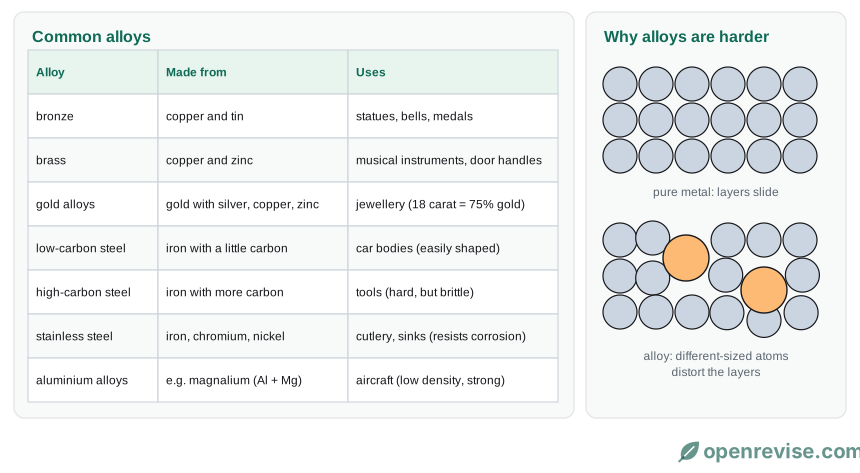
Most pure metals are too soft for many uses. In an alloy, atoms of different sizes distort the regular layers of metal atoms, so the layers cannot slide over each other as easily. Alloys are therefore harder and stronger than pure metals.
Copper alloys
- Bronze (copper and tin): hard and resists corrosion; used for statues, bells and medals.
- Brass (copper and zinc): hard but easily shaped; used for musical instruments, door handles and electrical plugs.
Gold alloys
Pure gold is very soft, so gold used for jewellery is usually an alloy with silver, copper and zinc. The proportion of gold is given in carats:
- 24 carat = 100% gold
- 18 carat = 18 ÷ 24 × 100 = 75% gold
- 9 carat = 9 ÷ 24 × 100 = 37.5% gold
Steels
Iron from the blast furnace is brittle, because it contains about 4% carbon. Most of it is made into steels:
- low-carbon steel: soft and easily shaped (car bodies, wire)
- high-carbon steel: very hard but brittle (cutting tools, blades)
- stainless steel (contains chromium and nickel): hard and resistant to corrosion (cutlery, sinks, surgical instruments)
Aluminium alloys
Aluminium has a low density. Its alloys, such as magnalium (aluminium and magnesium), are light but strong, so they are used for aircraft and bike frames.
Test yourself on this lesson
5 exam questions · 9 marks · with mark schemes and model answers
Found a mistake?