10.9 Ceramics, polymers and composites
How soda-lime and borosilicate glass and clay ceramics are made, how low and high density poly(ethene) differ, the structures of thermosoftening and thermosetting polymers, what composites are, and how to choose materials using their properties.
Ceramics
Key terms
- Ceramic: a hard, brittle material made by heating non-metal minerals, such as glass and clay ceramics.
- Soda-lime glass is made by heating sand, sodium carbonate and limestone. It is used for windows and bottles.
- Borosilicate glass is made from sand and boron trioxide. It melts at a higher temperature, so it is used for ovenware and laboratory glassware.
- Clay ceramics, such as pottery and bricks, are made by shaping wet clay and then heating it in a furnace.
Ceramics are hard, brittle, good insulators and have high melting points.
Polymers
The properties of a polymer depend on the monomers used and the conditions under which it is made.
- Low density poly(ethene) (LDPE): made at high pressure with a trace of oxygen. Branched chains; flexible. Used for bags and cling film.
- High density poly(ethene) (HDPE): made at lower temperature and pressure with a catalyst. Straighter chains packed closely; stronger and more rigid. Used for bottles and pipes.
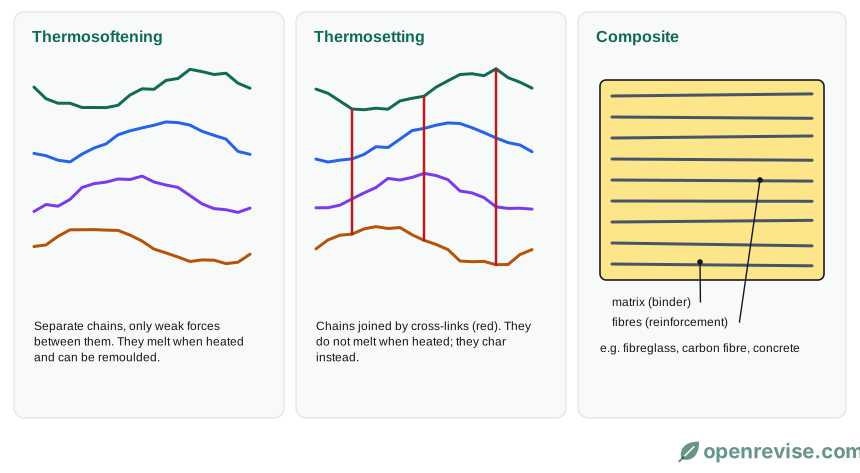
Key terms
- Thermosoftening polymer: a polymer made of separate chains that melts when heated and can be reshaped.
- Thermosetting polymer: a polymer whose chains are joined by cross-links, so it does not melt when heated.
Composites
Key terms
- Composite: a material made of two materials: a reinforcement (fibres or fragments) in a matrix or binder.
Composites combine the useful properties of each part. Examples: fibreglass (glass fibres in a polymer), carbon fibre composites, concrete (gravel in cement), and wood (cellulose fibres in lignin).
Choosing materials
| Material | Strength | Density | Conducts electricity | Other |
|---|---|---|---|---|
| metals | strong, malleable | high | yes | may corrode |
| ceramics | hard but brittle | medium | no | high melting point |
| polymers | flexible, low strength | low | no | easily moulded |
| composites | very strong | low | usually no | expensive |
Test yourself on this lesson
5 exam questions · 9 marks · with mark schemes and model answers
Found a mistake?