10.1 Finite resources, sustainability and recycling
Natural, synthetic, finite and renewable resources, what sustainable development means, and how reducing, reusing and recycling materials such as metals and glass saves resources and energy.
Using the Earth's resources
Key terms
- Finite resource: a resource that is being used up faster than it can be replaced, such as crude oil and metal ores.
- Renewable resource: a resource that can be replaced at the same rate as it is used, such as timber.
- Sustainable development: development that meets the needs of people today without stopping future generations from meeting their own needs.
We use the Earth's resources for warmth, shelter, food and transport.
- Natural resources from agriculture, such as cotton, wool and timber, are often supplemented or replaced by synthetic products, such as polymers and fertilisers.
- Chemistry is used to improve agricultural and industrial processes, so that they use resources more sustainably.
Reduce, reuse, recycle
Using less of a material, reusing it or recycling it:
- saves finite resources such as ores and crude oil
- saves energy, because extracting and processing raw materials uses a lot
- reduces waste in landfill and damage caused by mining and quarrying
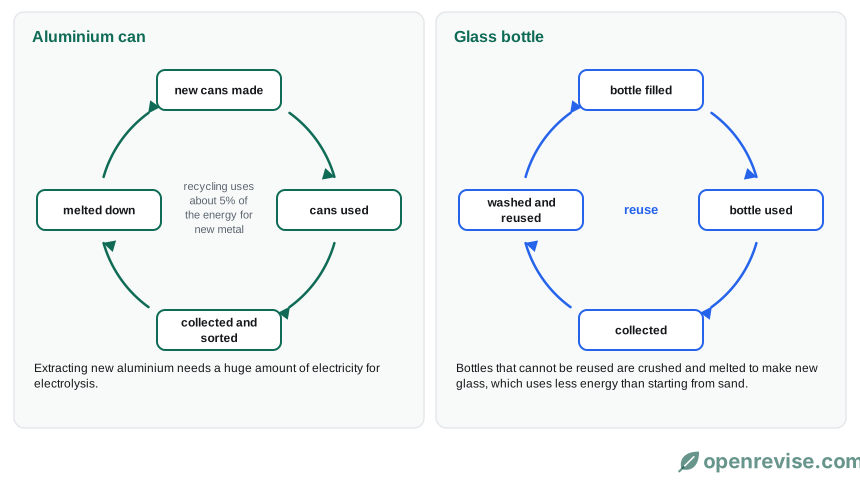
Recycling metals
Metals are recycled by melting and recasting or reforming into new products. The amount of separation needed depends on the metal and what it will be used for. For example, scrap steel can be added to iron from a blast furnace, reducing the amount of iron ore needed.
Reusing and recycling glass
Glass bottles can be reused after washing. Other glass can be crushed and melted to make different glass products.
Is recycling always worthwhile?
| For recycling | Against recycling |
|---|---|
| saves raw materials and energy | collecting, transporting and sorting cost money and energy |
| less waste in landfill | some materials are hard to separate |
| less mining and pollution | recycled material may be lower quality |
Test yourself on this lesson
5 exam questions · 8 marks · with mark schemes and model answers
Found a mistake?