9.4 Pollutants from burning fuels
The pollutants released when fuels burn, including carbon monoxide and soot from incomplete combustion, sulfur dioxide and oxides of nitrogen that cause acid rain, and particulates, with their effects on health and the environment.
Burning fuels
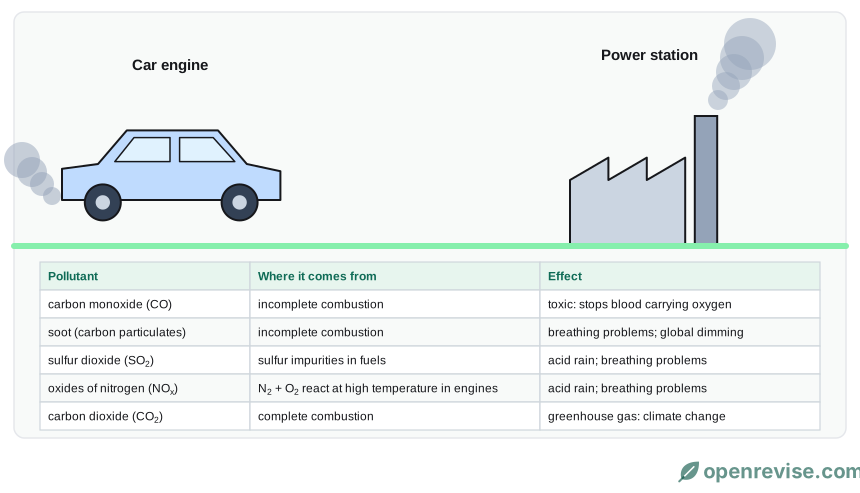
Fuels such as petrol, diesel and coal contain mainly carbon and hydrogen, and may also contain some sulfur. When they burn, the gases released can include carbon dioxide, water vapour, carbon monoxide, sulfur dioxide and oxides of nitrogen, as well as solid particles.
Incomplete combustion
Key terms
- Incomplete combustion: burning a fuel in a limited supply of oxygen, producing carbon monoxide and/or carbon (soot) as well as water.
- Particulates: tiny solid particles in the air, such as soot.
- Carbon monoxide is a toxic, colourless and odourless gas. It combines with haemoglobin in red blood cells, so the blood carries less oxygen. This can cause death.
- Soot (carbon particulates) can damage the lungs and cause global dimming (reducing sunlight reaching the Earth).
Example: 2CH4 + 3O2 → 2CO + 4H2O
Sulfur dioxide
Some fuels, especially coal, contain sulfur. When it burns, sulfur dioxide forms: S + O2 → SO2
Sulfur dioxide dissolves in rainwater to form acid rain, which damages buildings, kills trees and harms life in lakes. It also causes respiratory problems.
Oxides of nitrogen
At the very high temperatures inside engines, nitrogen and oxygen from the air react to form oxides of nitrogen (\mathrm{NO_x}). These also cause acid rain and breathing problems.
Reducing pollution
- Catalytic converters in cars convert carbon monoxide and oxides of nitrogen into carbon dioxide and nitrogen.
- Removing sulfur from fuels before burning them, or from power station waste gases.
- A good supply of air reduces incomplete combustion.
Test yourself on this lesson
5 exam questions · 10 marks · with mark schemes and model answers
Found a mistake?