10.4 Required practical: analysing and purifying water
AQA required practical: testing the pH of water samples, finding the mass of dissolved solids by evaporation, and purifying salty water by distillation, with how to check the purity of the distilled water.
AQA
1 min read
The practical
This is AQA required practical 8: analyse and purify water samples from different sources, including pH, dissolved solids and distillation.
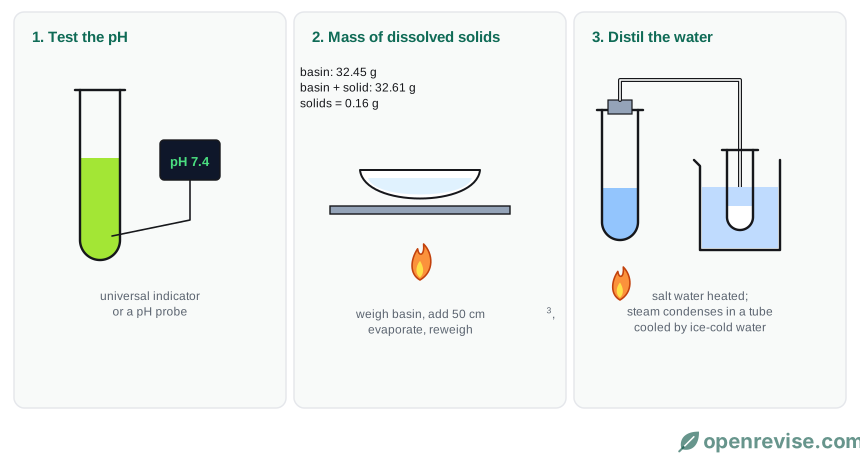
1. Testing the pH
Add a few drops of universal indicator and compare the colour with a chart, or use a pH probe for a more accurate reading. Potable water should be close to pH 7.
2. Mass of dissolved solids
- Weigh a clean, dry evaporating basin.
- Measure 50 cm3 of the water sample into it.
- Heat gently (for example over a water bath) to evaporate the water.
- Let the basin cool, then reweigh it.
- Mass of dissolved solids = final mass − mass of empty basin.
Example: 32.61 g − 32.45 g = 0.16 g in 50 cm3, so the concentration is 0.16 ÷ 0.050 = 3.2 g/dm3.
3. Distillation
- Heat the salty water in a boiling tube or flask.
- The water evaporates, and the steam passes along a delivery tube.
- It condenses in a test tube cooled in ice-cold water (or in a condenser).
- The salt is left behind.
Checking the distilled water is pure
- It should have pH 7.
- Evaporating it should leave no residue.
- It should boil at exactly 100 °C.
Safety
- Wear eye protection. Do not let the salty water boil dry.
- Remove the delivery tube from the cold test tube before you stop heating, to prevent suck-back.
Test yourself on this lesson
5 exam questions · 9 marks · with mark schemes and model answers
Found a mistake?