1.18 Multiplying and dividing fractions
Multiplying fractions and mixed numbers, simplifying before multiplying, dividing by a fraction by multiplying by its reciprocal, fractions of fractions, negative fractions, and problems in context.
Multiplying fractions
Key terms
- Reciprocal: the reciprocal of \frac{a}{b} is \frac{b}{a}. Multiplying a number by its reciprocal gives 1.
- Cancelling: dividing the numerator of one fraction and the denominator of another by a common factor before multiplying.
- Mixed number: a whole number and a fraction together, such as 1\frac{1}{2}.
- Fraction of a fraction: finding part of a fraction, which is done by multiplying.
Multiplying fractions is easier than adding them: you do not need a common denominator. Multiply the numerators together and the denominators together.
Worked example. Work out \dfrac{2}{3} \times \dfrac{3}{4}.
\dfrac{2 \times 3}{3 \times 4} = \dfrac{6}{12} = \dfrac{1}{2}.
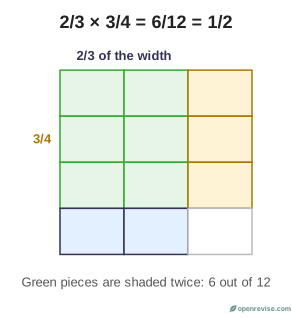
The area model shows why this works. The rectangle is split into 3 columns and 4 rows, making 12 equal pieces. The fraction \frac{2}{3} shades 2 of the columns and \frac{3}{4} shades 3 of the rows. The pieces shaded twice (the green region) are 2 \times 3 = 6 out of 3 \times 4 = 12, which is \frac{1}{2}.
Cancelling first
To keep numbers small, cancel before multiplying: divide any numerator and any denominator by a common factor. In \dfrac{2}{3} \times \dfrac{3}{4}, the 3 on the bottom of the first fraction and the 3 on the top of the second cancel, and 2 and 4 cancel by 2: \dfrac{1}{1} \times \dfrac{1}{2} = \dfrac{1}{2}.
Worked example. Work out \dfrac{3}{5} \times \dfrac{10}{21}. Cancel 3 with 21 (giving 1 and 7) and cancel 10 with 5 (giving 2 and 1): \dfrac{1}{1} \times \dfrac{2}{7} = \dfrac{2}{7}.
Fractions of a fraction. 'Of' means multiply. \dfrac{3}{4} of \dfrac{2}{5} is \dfrac{3}{4} \times \dfrac{2}{5} = \dfrac{6}{20} = \dfrac{3}{10}.
Fractions times whole numbers. Write the whole number as a fraction over 1. 6 \times \dfrac{2}{3} = \dfrac{6}{1} \times \dfrac{2}{3} = \dfrac{12}{3} = 4.
Mixed numbers
Always change mixed numbers to improper fractions before multiplying or dividing. Multiplying the whole numbers and the fractions separately gives the wrong answer.
Worked example. Work out 1\dfrac{1}{2} \times 2\dfrac{2}{3}.
1\dfrac{1}{2} = \dfrac{3}{2} and 2\dfrac{2}{3} = \dfrac{8}{3}. Then \dfrac{3}{2} \times \dfrac{8}{3} = \dfrac{24}{6} = 4. (Or cancel first: 3 with 3, and 8 with 2, giving \dfrac{1}{1} \times \dfrac{4}{1} = 4.)
Dividing fractions
To divide by a fraction, multiply by its reciprocal. Keep the first fraction, change the division to a multiplication, and turn the second fraction upside down.
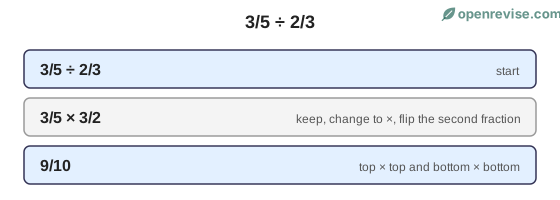
Worked example. Work out \dfrac{3}{5} \div \dfrac{2}{3}.
\dfrac{3}{5} \times \dfrac{3}{2} = \dfrac{9}{10}.
Why does this work? Dividing by a fraction asks 'how many of these fit?' For 2 \div \dfrac{1}{4}, you are asking how many quarters there are in 2. There are 4 quarters in each whole, so there are 2 \times 4 = 8. Using the rule: 2 \times \dfrac{4}{1} = 8.
Worked example. Work out 1\dfrac{1}{2} \div \dfrac{3}{4}.
\dfrac{3}{2} \times \dfrac{4}{3} = \dfrac{12}{6} = 2.
Dividing by a whole number. \dfrac{5}{6} \div 10 = \dfrac{5}{6} \times \dfrac{1}{10} = \dfrac{5}{60} = \dfrac{1}{12}.
Negative fractions
The rules for signs are the same as for other numbers: same signs give a positive answer, different signs give a negative answer.
- -\dfrac{2}{3} \times \dfrac{9}{10} = -\dfrac{18}{30} = -\dfrac{3}{5}
- \left(-\dfrac{3}{4}\right) \div \left(-\dfrac{1}{2}\right) = \dfrac{3}{4} \times 2 = \dfrac{3}{2} = 1\dfrac{1}{2}
Problems
Worked example. A recipe uses \dfrac{3}{4} cup of sugar to make 12 biscuits. How much sugar is needed for 8 biscuits?
8 biscuits is \dfrac{8}{12} = \dfrac{2}{3} of the recipe. So the sugar is \dfrac{2}{3} \times \dfrac{3}{4} = \dfrac{6}{12} = \dfrac{1}{2} cup.
Worked example. A sack holds 4\dfrac{1}{2} kg of rice. How many bags of \dfrac{3}{8} kg can be filled?
4\dfrac{1}{2} \div \dfrac{3}{8} = \dfrac{9}{2} \times \dfrac{8}{3} = \dfrac{72}{6} = 12 bags.
Common mistakes
- Using a common denominator when multiplying. You do not need one: just multiply across.
- Flipping the wrong fraction when dividing, or flipping both.
- Multiplying the whole numbers and the fraction parts of mixed numbers separately.
- Forgetting to simplify the answer.
Estimating and checking
Think about the size of your answer before you calculate. Multiplying by a fraction less than 1 makes a number smaller: \frac{2}{3} \times \frac{3}{4} = \frac{1}{2} is smaller than both \frac{2}{3} and \frac{3}{4}. Multiplying by a fraction greater than 1 (an improper fraction or mixed number) makes the number bigger. In the same way, dividing by a fraction less than 1 makes the answer bigger: 2 \div \frac{1}{4} = 8 is larger than 2. If your answer does not match this, check your working.
You can also check with decimals: \frac{3}{5} \div \frac{2}{3} = 0.6 \div 0.667 = 0.9, which agrees with \frac{9}{10}.
Why does multiplying by the reciprocal work?
Dividing by \frac{2}{3} asks how many thirds-times-two fit into the first number. Imagine you want to know how many pieces of length \frac{2}{3} m can be cut from a rope that is 4 m long. Each metre has 3 thirds, so 4 m has 12 thirds. Each piece uses 2 thirds, so there are 12 \div 2 = 6 pieces. In symbols, 4 \div \frac{2}{3} = 4 \times \frac{3}{2} = 6. You always multiply by the denominator (to count the pieces) and divide by the numerator (to find how many pieces fit), which is exactly what multiplying by the reciprocal does.
Fractions in context
Multiplying fractions is used whenever you want a fraction of a fraction: three-quarters of a tank that is two-fifths full, or a fifth of the half of a cake that remains. Dividing fractions is used to find how many portions or bags can be filled, such as how many \frac{3}{8} kg bags can be made from a large sack. When you set out your working in an exam, write the calculation, the cancelling (if you use it) and the final simplified answer. Each part can earn a mark, even if one step is wrong.
Summary
- Multiply: top times top, bottom times bottom. Cancel first to keep numbers small.
- Divide: keep the first fraction, change \div to \times, and flip the second fraction.
- Convert mixed numbers to improper fractions before multiplying or dividing.
- Whole numbers can be written over 1.
Test yourself on this lesson
9 exam questions · 21 marks · with mark schemes and model answers
Found a mistake?