1.19 Converting between fractions, decimals and percentages
Converting between fractions, terminating decimals and percentages in both directions, recalling the common equivalents, ordering a mixture of the three, and recognising which fractions give terminating decimals.
Three ways to write the same number
Key terms
- Percentage: a number written as a fraction out of 100. The word 'per cent' means 'per hundred'.
- Terminating decimal: a decimal that ends, such as 0.375.
- Recurring decimal: a decimal with a digit or block of digits that repeats forever, such as 0.333...
- Equivalent: having the same value, even if written in a different form.
Fractions, decimals and percentages are three different ways of writing the same quantity. The number one half can be written as \frac{1}{2}, as 0.5 or as 50%. Being able to move between the forms quickly is an essential skill: it is used in probability, in money problems, in statistics and in comparing data.
Percentages and decimals
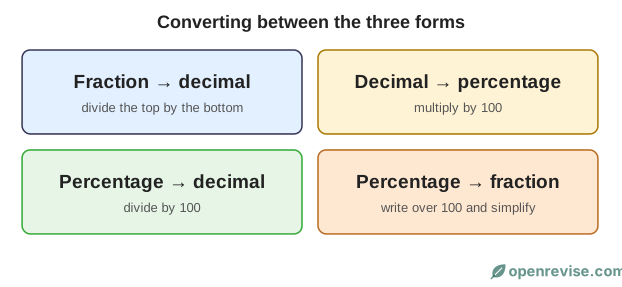
A percentage is a number out of 100. To change a percentage to a decimal, divide by 100 (move the digits two places to the right). To change a decimal to a percentage, multiply by 100 (move the digits two places to the left).
- 45\% = 45 \div 100 = 0.45
- 7\% = 0.07
- 120\% = 1.2 (a percentage above 100% gives a decimal above 1)
- 0.6 = 0.6 \times 100 = 60\%
- 0.375 = 37.5\%
Percentages and fractions
To change a percentage to a fraction, write it over 100 and simplify.
35\% = \dfrac{35}{100} = \dfrac{7}{20} (dividing by 5). 12.5\% = \dfrac{12.5}{100} = \dfrac{125}{1000} = \dfrac{1}{8}.
To change a fraction to a percentage, either make the denominator 100 (when that is easy) or change to a decimal and multiply by 100. \dfrac{7}{20} = \dfrac{35}{100} = 35\%. \dfrac{3}{8} = 0.375 = 37.5\%.
Fractions and decimals
To change a fraction to a decimal, divide the numerator by the denominator, because a fraction is a division. For \dfrac{3}{8} do 3 \div 8 using short division: 8 into 30 goes 3 remainder 6, 8 into 60 goes 7 remainder 4, 8 into 40 goes 5. The answer is 0.375.
To change a decimal to a fraction, use place value. The last digit tells you the denominator: tenths, hundredths or thousandths. Then simplify.
- 0.6 = \dfrac{6}{10} = \dfrac{3}{5}
- 0.35 = \dfrac{35}{100} = \dfrac{7}{20}
- 0.125 = \dfrac{125}{1000} = \dfrac{1}{8}
- 2.4 = 2\dfrac{4}{10} = 2\dfrac{2}{5} = \dfrac{12}{5}
Equivalents to learn
| Fraction | Decimal | Percentage |
|---|---|---|
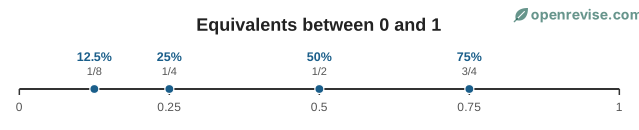
| \frac{1}{2} | 0.5 | 50% |
| \frac{1}{4} | 0.25 | 25% |
| \frac{3}{4} | 0.75 | 75% |
| \frac{1}{5} | 0.2 | 20% |
| \frac{1}{10} | 0.1 | 10% |
| \frac{1}{8} | 0.125 | 12.5% |
| \frac{3}{8} | 0.375 | 37.5% |
| \frac{1}{3} | 0.333... | 33.3...% |
| \frac{2}{3} | 0.666... | 66.6...% |
Ordering fractions, decimals and percentages
To compare numbers in different forms, change them all into the same form, usually decimals.
Worked example. Put 0.45, \dfrac{2}{5}, 42\% and \dfrac{9}{25} in order, smallest first.
As decimals: 0.45, 0.4, 0.42 and 9 \div 25 = 0.36. In order: 0.36, 0.4, 0.42, 0.45, which is \dfrac{9}{25}, \dfrac{2}{5}, 42\%, 0.45. Always write the answer in the form the question started with.
Worked example. Ali scored \dfrac{27}{40} in a test and Ben scored 66%. Who did better?
\dfrac{27}{40} = 0.675 = 67.5\%, which is higher than 66%, so Ali did better.
Which fractions give terminating decimals?
A fraction in simplest form gives a terminating decimal if the denominator has only 2 and 5 as prime factors. Denominators such as 2, 4, 5, 8, 10, 20 and 25 all terminate. A fraction with any other prime factor in the denominator (3, 7, 11, ...) gives a recurring decimal: \dfrac{1}{3} = 0.333..., \dfrac{5}{12} = 0.41666... because 12 = 2^2 \times 3. Recurring decimals are covered in the next lesson.
Exam-style example
Question. Write 0.35, \dfrac{3}{8} and 36\% in order, smallest first.
Answer. 0.35 stays as 0.35, \dfrac{3}{8} = 0.375 and 36\% = 0.36. In order: 0.35, 36\%, \dfrac{3}{8}.
Common mistakes
- Writing 0.4 = 4\%. It is 0.4 \times 100 = 40\%.
- Writing 5\% = 0.5. The correct decimal is 5 \div 100 = 0.05.
- Mixing up \dfrac{1}{8} = 0.125 with 0.18.
- Forgetting to simplify a fraction, for example leaving \dfrac{35}{100} instead of \dfrac{7}{20}.
- Saying that percentages cannot be more than 100%: they can, for example when something has more than doubled.
Why does percentage mean 'out of 100'?
The word percent comes from the Latin per centum, which means 'for each hundred'. So 35% means 35 for every 100, which is the fraction \frac{35}{100} or the decimal 0.35. A hundred square is a good picture: a 10 by 10 grid has 100 small squares, so shading 35 of them shows 35%, \frac{35}{100} and 0.35 all at once. Because every percentage is a fraction with denominator 100, converting between the forms is only a matter of dividing or multiplying by 100 and simplifying.
A step-by-step method for each conversion
Fraction to percentage. (1) Divide the numerator by the denominator to get a decimal. (2) Multiply by 100. Alternatively, if the denominator is a factor of 100 (such as 2, 4, 5, 10, 20, 25 or 50), multiply the top and bottom by the number that makes the denominator 100: \dfrac{7}{20} = \dfrac{35}{100} = 35\%.
Percentage to fraction. (1) Write the percentage as the numerator over 100. (2) If the percentage has a decimal, multiply the top and bottom by 10 to remove it. (3) Simplify by dividing by the highest common factor. For example, 12.5\% = \dfrac{12.5}{100} = \dfrac{125}{1000} = \dfrac{1}{8}.
Decimal to fraction. (1) Write the digits after the point over a power of 10: tenths, hundredths or thousandths. (2) Simplify.
Checking. After converting, change back to the starting form. If \dfrac{3}{8} = 37.5\%, then 37.5% as a decimal is 0.375, and 0.375 = \dfrac{375}{1000} = \dfrac{3}{8}, so the conversion is correct.
Percentages greater than 100%
A percentage above 100% means more than the whole. If a population doubles it has increased to 200% of its original size, which is 2 as a decimal. A percentage such as 150% is 1.5 as a decimal and \dfrac{3}{2} as a fraction. Percentages like these are used in percentage increase problems and in growth, which you will meet in the ratio and proportion topic.
Summary
- Percentage to decimal: divide by 100. Decimal to percentage: multiply by 100.
- Percentage to fraction: put over 100 and simplify.
- Fraction to decimal: divide the top by the bottom.
- Decimal to fraction: use place value, then simplify.
- To order different forms, convert them all to decimals.
- Know the common equivalents in the table.
Test yourself on this lesson
9 exam questions · 19 marks · with mark schemes and model answers
Found a mistake?