1.20 Recurring decimals
Higher tier: writing fractions as recurring decimals with dot notation, and converting recurring decimals to fractions using the multiply-and-subtract algebra method, including mixed recurring decimals and proofs.
Terminating and recurring decimals
Key terms
- Terminating decimal: a decimal that ends after a finite number of digits, such as 0.25.
- Recurring decimal: a decimal in which a digit or group of digits repeats forever, such as 0.7777...
- Dot notation: dots written over the first and last digit of the repeating block, for example 0.\dot{4}\dot{5} = 0.454545...
- Rational number: a number that can be written as a fraction of two integers. Every recurring and terminating decimal is rational.
When you convert a fraction to a decimal by dividing, one of two things happens. Either the division ends (a terminating decimal) or the same remainder appears again and the digits repeat forever (a recurring decimal). For example \dfrac{1}{3} = 0.333... and \dfrac{5}{6} = 0.8333... Both numbers are exact fractions, even though the decimals do not stop.
Dot notation
We write recurring decimals using dots above the repeating digits.
- A single repeating digit has one dot: 0.333... = 0.\dot{3}.
- A block of digits has a dot over the first and the last digit of the block: 0.454545... = 0.\dot{4}\dot{5} and \dfrac{1}{7} = 0.142857142857... = 0.\dot{1}4285\dot{7}.
- Digits before the repeating part are not dotted: \dfrac{5}{6} = 0.8333... = 0.8\dot{3}.
| Fraction | Decimal | Dot notation |
|---|---|---|
| \frac{1}{3} | 0.3333... | 0.\dot{3} |
| \frac{2}{3} | 0.6666... | 0.\dot{6} |
| \frac{1}{9} | 0.1111... | 0.\dot{1} |
| \frac{5}{6} | 0.8333... | 0.8\dot{3} |
| \frac{1}{11} | 0.090909... | 0.\dot{0}\dot{9} |
| \frac{1}{7} | 0.142857142857... | 0.\dot{1}4285\dot{7} |
Converting a recurring decimal to a fraction
To change a recurring decimal to a fraction, use algebra. The idea is to multiply the decimal by a power of 10 so that the repeating parts line up, and then subtract to remove them.
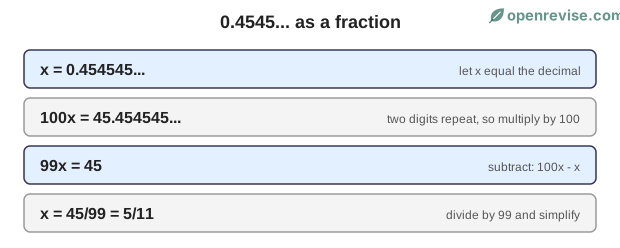
Method:
- Let x equal the recurring decimal.
- Multiply by 10 if one digit repeats, 100 if two digits repeat, 1000 if three digits repeat, and so on.
- Subtract the original equation from the new one. The infinitely long recurring parts cancel.
- Solve for x and simplify the fraction.
Worked example (one digit). Write 0.\dot{7} as a fraction.
Let x = 0.7777... Then 10x = 7.7777... Subtract: 10x - x = 7.7777... - 0.7777..., so 9x = 7 and x = \dfrac{7}{9}.
Worked example (two digits). Write 0.\dot{4}\dot{5} as a fraction in its simplest form.
Let x = 0.454545... Then 100x = 45.454545... Subtract: 99x = 45, so x = \dfrac{45}{99} = \dfrac{5}{11}.
Worked example (three digits). Write 0.\dot{1}2\dot{3} as a fraction. Let x = 0.123123... Then 1000x = 123.123123... Subtract: 999x = 123, so x = \dfrac{123}{999} = \dfrac{41}{333}.
Mixed recurring decimals
If digits before the recurring block do not repeat, you need two multiplications so that the recurring parts line up.
Worked example. Write 0.1\dot{6} as a fraction.
Let x = 0.16666... Then 10x = 1.6666... and 100x = 16.6666... Subtract: 100x - 10x = 16.6666... - 1.6666..., so 90x = 15 and x = \dfrac{15}{90} = \dfrac{1}{6}.
Worked example. Write 0.2\dot{3} as a fraction. Let x = 0.23333... Then 10x = 2.3333... and 100x = 23.3333... Subtract: 90x = 21, so x = \dfrac{21}{90} = \dfrac{7}{30}. Check: 7 \div 30 = 0.2333...
Fractions to recurring decimals
Divide the numerator by the denominator. When a remainder repeats, the digits repeat. For example 2 \div 9 = 0.222..., so \dfrac{2}{9} = 0.\dot{2}. The block can be long: \dfrac{1}{7} repeats after 6 digits.
Which fractions terminate? A fraction in its simplest form is a terminating decimal if its denominator has only the prime factors 2 and 5. For \dfrac{7}{16}: 16 = 2^4, so it terminates (0.4375). For \dfrac{4}{15}: 15 = 3 \times 5, so it recurs (0.2\dot{6}). Always simplify first: \dfrac{6}{15} = \dfrac{2}{5} = 0.4 terminates, even though 15 includes a factor of 3.
Exam-style example
Question. Prove that 0.4\dot{5} = \dfrac{41}{90}.
Answer. Let x = 0.45555... Then 10x = 4.5555... and 100x = 45.5555... Subtract: 100x - 10x = 45.5555... - 4.5555..., so 90x = 41. Therefore x = \dfrac{41}{90}, as required.
Common mistakes
- Multiplying by the wrong power of 10. The power must match the number of digits in the repeating block.
- Forgetting to subtract, or subtracting the wrong lines.
- Not simplifying the fraction at the end.
- Using the 'over 9s' rule for a decimal like 0.1\dot{6}, where the repeating block does not start straight after the point.
- Writing 0.\dot{7} = 0.7. The decimals are different numbers.
Why do some decimals recur?
When you divide the numerator of a fraction by its denominator using long division, each step produces a remainder. If the denominator is n, the only possible remainders are 0, 1, 2, ..., n - 1. Either the remainder reaches 0 (the division ends, giving a terminating decimal) or, after at most n - 1 steps, a remainder repeats. Once a remainder repeats, the same digits are produced again and again, so the decimal recurs. This shows that the repeating block can be at most n - 1 digits long: for \frac{1}{7} the block has 6 digits, and for \frac{1}{11} it has 2.
This also explains why every recurring decimal is a fraction. The repeating pattern means the algebra method (multiply by a power of 10 and subtract) always removes the infinite tail and leaves a whole number divided by a whole number.
Summary
- A recurring decimal repeats forever and is shown with dots; every recurring decimal is a fraction.
- To convert: let x be the decimal, multiply by 10^n (where n is the length of the repeating block), subtract and solve.
- For mixed recurring decimals, multiply twice so the repeating parts line up.
- A fraction in simplest form is a terminating decimal only if the denominator has no prime factors except 2 and 5.
Test yourself on this lesson
9 exam questions · 24 marks · with mark schemes and model answers
Found a mistake?