1.21 Fractions of a quantity
Finding a fraction of a quantity, fractions greater than 1, expressing one quantity as a fraction of another, working backwards to find the whole, and successive fractions of an amount.
Finding a fraction of a quantity
Key terms
- Fraction of a quantity: a part of an amount, found by dividing by the denominator and multiplying by the numerator.
- Unit fraction: a fraction with 1 as the numerator, such as \frac{1}{5}.
- Whole: the full amount, which is 100% or \frac{1}{1}.
- Operator: a fraction used to change a quantity, as in 'increase by \frac{1}{3}'.
To find a fraction of an amount, think of the denominator as the number of equal parts the amount is cut into, and the numerator as the number of parts you need. This gives the method:
- Divide the amount by the denominator to find one part (the unit fraction).
- Multiply by the numerator to find the required number of parts.
Worked example. Find \dfrac{3}{5} of £40.
Divide by 5: 40 \div 5 = 8. Multiply by 3: 8 \times 3 = 24. The answer is £24.
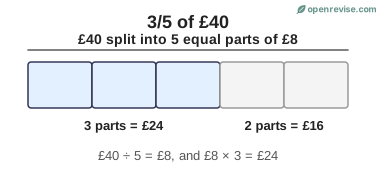
The bar model shows why this works: £40 is cut into 5 equal parts of £8, and 3 of the parts make £24. Drawing a bar model helps you to check that your answer is sensible.
Worked example. Find \dfrac{1}{4} of 36 kg. 36 \div 4 = 9 kg.
Worked example. Find \dfrac{5}{8} of 72 kg. 72 \div 8 = 9 and 9 \times 5 = 45 kg.
Fractions greater than 1
An improper fraction or a mixed number of a quantity is bigger than the quantity itself.
Worked example. Find \dfrac{5}{4} of 24. 24 \div 4 = 6 and 6 \times 5 = 30.
Worked example. Find 1\dfrac{1}{2} of 18. This is 18 + \dfrac{1}{2} \times 18 = 18 + 9 = 27. (Or \dfrac{3}{2} of 18: 18 \div 2 = 9 and 9 \times 3 = 27.)
On a calculator you can enter a fraction and multiply: for example \dfrac{3}{7} \times 245 = 105. In a non-calculator exam you should use the divide-then-multiply method.
Expressing one quantity as a fraction of another
To write one quantity as a fraction of another, put the part over the whole, make sure they are in the same units, and simplify.
Worked example. Write 35 minutes as a fraction of 2 hours.
Change 2 hours to minutes: 120 minutes. The fraction is \dfrac{35}{120} = \dfrac{7}{24}.
Worked example. Write 45p as a fraction of £3. £3 is 300p, so \dfrac{45}{300} = \dfrac{3}{20}.
The same units are essential. A mistake would be to write \dfrac{35}{2}, which compares minutes with hours.
Working backwards to find the whole
Sometimes you are given the part and the fraction and have to find the whole.
Worked example. \dfrac{3}{5} of a number is 24. Find the number.
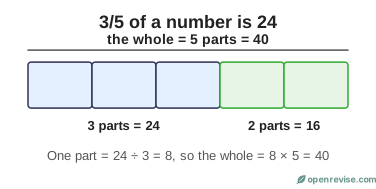
3 parts are worth 24, so 1 part is 24 \div 3 = 8. The whole is 5 parts, so the number is 8 \times 5 = 40. In general, divide by the numerator to find one part, and multiply by the denominator to find the whole.
Worked example. A shop reduces the price of a jacket by \dfrac{1}{4}. The sale price is £63. What was the original price?
The sale price is 1 - \dfrac{1}{4} = \dfrac{3}{4} of the original. 63 \div 3 = 21 is one quarter, so the original price is 21 \times 4 = £84.
Fractions as operators
An 'increase by a fraction' means add that fraction of the amount.
- Increase 60 by \dfrac{1}{3}: \dfrac{1}{3} of 60 is 20, so the new amount is 60 + 20 = 80.
- Decrease 60 by \dfrac{2}{5}: \dfrac{2}{5} of 60 is 24, so the new amount is 60 - 24 = 36. A quicker way is \dfrac{3}{5} of 60, because 1 - \dfrac{2}{5} = \dfrac{3}{5}.
Successive fractions
When fractions are taken one after another, be careful about what each fraction is of.
Worked example. Ria has £360. She spends \dfrac{1}{3} of it on rent and then \dfrac{1}{4} of the remainder on food. How much does she have left?
Rent: 360 \div 3 = 120, so £240 remains. Food: 240 \div 4 = 60, so 240 - 60 = £180 is left. Alternatively, she has \dfrac{2}{3} \times \dfrac{3}{4} = \dfrac{1}{2} left, which is £180.
Exam-style example
Question. There are 32 students in a class. \dfrac{3}{8} are left-handed. Of the left-handed students, \dfrac{1}{3} are girls. How many left-handed girls are in the class?
Answer. Left-handed students: 32 \div 8 = 4 and 4 \times 3 = 12. Left-handed girls: \dfrac{1}{3} of 12 = 4. There are 4 left-handed girls.
Common mistakes
- Multiplying instead of dividing the whole by the denominator first, which gives an answer far too big.
- Giving the answer as a fraction when the question asks for an amount.
- Not using the same units when writing one quantity as a fraction of another.
- Taking the second fraction of the original amount instead of the remainder.
- Forgetting to simplify.
Checking your answer
A fraction of an amount should make sense. \dfrac{3}{5} is a bit more than one half, so \dfrac{3}{5} of £40 should be a bit more than £20: the answer £24 fits. A fraction less than 1 gives a smaller amount than the whole, and a fraction greater than 1 gives a bigger amount. If your answer is outside these ranges, check your working. In 'find the whole' questions, the answer should be bigger than the part you were given.
Fractions in real life
Fractions of amounts are used for shares ('\frac{2}{5} of the profit'), discounts ('\frac{1}{3} off'), recipes, distances ('we have gone \frac{3}{4} of the way'), and data ('\frac{3}{8} of the class are left-handed'). When a question gives you a fraction and a quantity in words, underline the whole and say what the fraction is of. That tells you which number to divide.
Summary
- A fraction of an amount: divide by the denominator, multiply by the numerator.
- Improper fractions and mixed numbers give an answer bigger than the amount.
- To write one quantity as a fraction of another, use the same units and simplify.
- To find the whole: divide the part by the numerator and multiply by the denominator.
- For successive fractions, take care what each fraction is of.
Test yourself on this lesson
9 exam questions · 19 marks · with mark schemes and model answers
Found a mistake?