1.22 Metric units, time and money
Standard metric units of length, mass and capacity and converting between them, 12-hour and 24-hour clock times, time calculations and timetables, and money problems including pounds and pence and exchange rates.
Metric units
Key terms
- Metric system: a system of units based on powers of 10, using prefixes such as kilo, centi and milli.
- Prefix: a word at the start of a unit that shows its size, for example kilo- means 1000.
- Conversion factor: the number you multiply or divide by to change from one unit to another.
- 24-hour clock: a way of writing times from 00:00 to 23:59 without using am or pm.
The metric system is based on 10, so converting between units means multiplying or dividing by 10, 100 or 1000. The prefixes tell you the size:
| Prefix | Meaning | Example |
|---|---|---|
| kilo- (k) | 1000 times the base unit | 1 kilometre = 1000 metres |
| centi- (c) | one hundredth of the base unit | 1 centimetre = 0.01 metres |
| milli- (m) | one thousandth of the base unit | 1 millimetre = 0.001 metres |
| Quantity | Conversions |
|---|---|
| Length | 1 km = 1000 m; 1 m = 100 cm; 1 cm = 10 mm; 1 m = 1000 mm |
| Mass | 1 tonne = 1000 kg; 1 kg = 1000 g; 1 g = 1000 mg |
| Capacity | 1 litre = 1000 ml; 1 litre = 100 cl; 1 cl = 10 ml |
Converting units
Moving from a larger unit to a smaller unit gives a bigger number, so multiply. Moving from a smaller unit to a larger unit gives a smaller number, so divide.
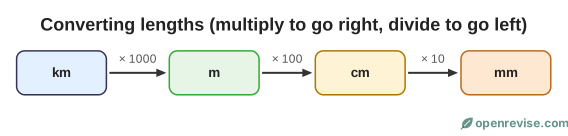
Worked example. Convert (a) 3.4 km to metres, (b) 450 cm to metres, (c) 2.5 kg to grams, (d) 750 ml to litres.
(a) km to m: multiply by 1000, so 3.4 \times 1000 = 3400 m. (b) cm to m: divide by 100, so 450 \div 100 = 4.5 m. (c) 2.5 \times 1000 = 2500 g. (d) ml to litres: divide by 1000, so 750 \div 1000 = 0.75 litres.
Worked example. Convert 0.6 m to centimetres and millimetres. 0.6 \times 100 = 60 cm and 0.6 \times 1000 = 600 mm.
Imperial units
You may meet imperial units such as inches, feet, yards, miles, ounces, pounds, pints and gallons. You are not expected to memorise the conversions between imperial and metric units: the exam question will give them (for example 'use 1 inch = 2.54 cm'). Use the same multiply or divide reasoning with the given factor.
Time
| 60 seconds = 1 minute | 60 minutes = 1 hour | 24 hours = 1 day |
|---|---|---|
| 7 days = 1 week | 12 months = 1 year | 365 days = 1 year (366 in a leap year) |
12-hour and 24-hour clocks. The 24-hour clock avoids am and pm. For times from 1 pm onwards, add 12 hours: 3:45 pm is 15:45. Midnight is 00:00 and noon is 12:00. 00:30 is 12:30 am and 12:30 pm is 12:30.
Time calculations. To find the difference between two times, count up to the next whole hour, then the whole hours, then the extra minutes.
Worked example. How long is it from 09:50 to 14:25? From 09:50 to 10:00 is 10 minutes; from 10:00 to 14:00 is 4 hours; from 14:00 to 14:25 is 25 minutes. Total: 4 hours 35 minutes.
Worked example. A film starts at 18:35 and lasts 2 hours 40 minutes. When does it finish? Adding 2 hours gives 20:35; adding 40 minutes gives 21:15. It finishes at 21:15.
Decimal hours. Be careful: 2.5 hours is 2 hours 30 minutes, but 1.2 hours is 1 hour and 0.2 \times 60 = 12 minutes, not 1 hour 20 minutes. To change minutes to a decimal hour, divide by 60: 45 minutes = 0.75 hours.
Money
Money is written with a decimal point and two decimal places. £1 = 100p, so £4.5 should be written £4.50, and 85p is £0.85. Calculations with money use the same methods as decimals.
Exchange rates. An exchange rate tells you how many units of one currency equal one unit of another. If £1 = €1.15, then £80 is 80 \times 1.15 = €92. To convert back, divide: €92 \div 1.15 = £80. Other currencies, such as dollars (\$) and cents, work in the same way.
Exam-style example
Question. A train leaves at 09:48 and arrives at 11:17. (a) How long does the journey take? (b) The return train takes the same time and leaves at 14:50. When does it arrive?
Answer. (a) 09:48 to 10:00 is 12 minutes; 10:00 to 11:00 is 1 hour; 11:00 to 11:17 is 17 minutes. Total: 1 hour 29 minutes. (b) 14:50 + 1 hour is 15:50, and 15:50 + 29 minutes is 16:19. It arrives at 16:19.
Question. A recipe needs 0.35 kg of butter. A shop sells butter in 125 g packs. How many packs are needed?
Answer. 0.35 \text{ kg} = 350 \text{ g}, and 350 \div 125 = 2.8. You cannot buy part of a pack, so you need 3 packs.
Common mistakes
- Multiplying instead of dividing (or the other way round) when converting.
- Treating decimal hours as minutes: 1.5 hours is 90 minutes, not 150.
- Making mistakes with am and pm: 12:30 pm is 12:30, but 12:30 am is 00:30.
- Writing money as £4.5 instead of £4.50, or mixing pounds and pence in a calculation.
Checking whether an answer is sensible
It helps to know some typical measurements so you can tell whether a converted answer makes sense. A door is about 2 m high, a pencil about 15 cm long, a bag of sugar weighs 1 kg, a teaspoon holds about 5 ml, a can of drink holds 330 ml, and a school lesson lasts about an hour. If you convert the width of a classroom (about 8 m) to centimetres and get 8 cm, you can see that your answer is a hundred times too small. If you convert 2.5 litres to millilitres and get 25 ml, you have divided by 100 instead of multiplying by 1000.
Using a calculator for conversions
On a calculator, enter the conversion as a single calculation: for example 3.4 \times 1000 for kilometres to metres. For time calculations that cross the hour (such as 09:50 to 14:25), do not subtract the numbers 14.25 and 9.50 as decimals: the digits are minutes out of 60, not out of 100. Use the 'count up' method instead, or convert each time to minutes after midnight and subtract.
Summary
- Metric units are linked by powers of 10: kilo = 1000, centi = 1/100, milli = 1/1000.
- Larger to smaller unit: multiply. Smaller to larger unit: divide.
- Know the units of time and how to use the 24-hour clock.
- Calculate time differences by counting to the next hour.
- Use exchange rates by multiplying (or dividing to convert back).
Test yourself on this lesson
9 exam questions · 20 marks · with mark schemes and model answers
Found a mistake?