1.23 Estimating answers
Estimating the answer to a calculation by rounding each number to one significant figure, checking calculator answers, working out whether an estimate is an over- or under-estimate, and estimating roots and money.
Why estimate?
Key terms
- Estimate: an approximate answer found by rounding the numbers to make the calculation easy.
- Approximation: a value that is close to, but not exactly equal to, the true value.
- Significant figure: a digit that carries meaning. The first significant figure is the first digit that is not zero.
- Over-estimate: an estimate that is bigger than the true value. An under-estimate is smaller.
An estimate is a quick calculation that gives an answer close to the exact one. Estimating is useful for three reasons. First, it lets you check that an answer from a calculator is sensible, because it is easy to press the wrong key. Second, you can find an answer without a calculator. Third, in real life you often do not need an exact value: you just need to know roughly how much something costs or how long it will take.
The method
- Round every number to 1 significant figure (the first digit that is not zero).
- Do the calculation with the rounded numbers. You should be able to do it without a calculator.
- Write down the rounded values and the estimate, so that the examiner can see your method.
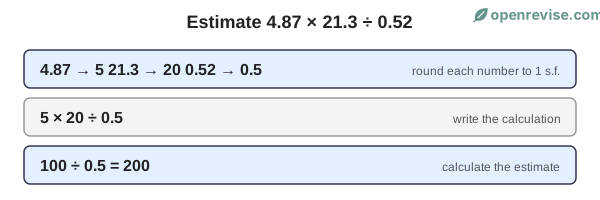
Worked example. Work out an estimate for \dfrac{4.87 \times 21.3}{0.52}.
Round to 1 s.f.: 4.87 becomes 5, 21.3 becomes 20 and 0.52 becomes 0.5. The calculation is \dfrac{5 \times 20}{0.5} = \dfrac{100}{0.5} = 200. The exact answer is 199.5, so the estimate is excellent.
Worked example. Work out an estimate for \dfrac{38.6 + 11.2}{2.1 \times 4.9}.
Round: 38.6 to 40, 11.2 to 10, 2.1 to 2 and 4.9 to 5. The top is 40 + 10 = 50 and the bottom is 2 \times 5 = 10. The estimate is 50 \div 10 = 5.
Worked example. Work out an estimate for \dfrac{6.82 \times 3.14}{0.21}.
\dfrac{7 \times 3}{0.2} = \dfrac{21}{0.2} = 105.
Worked example. Work out an estimate for \dfrac{7.8 \times 19.6}{0.039}. Round 7.8 to 8, 19.6 to 20 and 0.039 to 0.04. Then \dfrac{8 \times 20}{0.04} = \dfrac{160}{0.04} = 4000.
| Number | Rounded to 1 s.f. | Reason |
|---|---|---|
| 4.87 | 5 | the next digit, 8, is 5 or more |
| 21.3 | 20 | the next digit, 1, is less than 5 |
| 4952 | 5000 | the next digit, 9, is 5 or more |
| 0.0486 | 0.05 | the first significant figure is the 4 |
Estimating roots and powers
To estimate a square root, use the nearest perfect square. For \sqrt{82.5}, the nearest square is 81 = 9^2, so the estimate is 9. For \sqrt[3]{70}, the nearest cube is 64 = 4^3, so the estimate is 4.
Over-estimates and under-estimates
To decide whether an estimate is bigger or smaller than the true value, think about what each rounding does to the overall answer.
- Rounding a number that you multiply or the top of a fraction up makes the answer bigger.
- Rounding a number that you divide by (the bottom of a fraction) up makes the answer smaller.
Worked example. 48.7 \div 0.52 is estimated as 50 \div 0.5 = 100. The top is rounded up (bigger answer), and the bottom is rounded down (which also makes the answer bigger). So the estimate is an over-estimate. The true value is 93.65.
Checking calculator answers
Suppose a calculator shows 0.49 \times 810 = 3969. Estimate: 0.5 \times 800 = 400. The answer 3969 is ten times too big, so a decimal point error has been made. The correct answer is 396.9.
Estimating in context
Worked example. Tickets cost £11.95 each. Estimate the cost of 38 tickets. Round 38 to 40 and £11.95 to £12: 40 \times 12 = £480. The exact cost is £454.10, so the estimate is a little high.
Exam-style example
Question. (a) Write 4952 and 0.0486 correct to 1 significant figure. (b) Work out an estimate for \dfrac{4952 \times 0.0486}{0.52}. (c) Is your estimate bigger or smaller than the exact answer? Give a reason.
Answer. (a) 5000 and 0.05. (b) Round 0.52 to 0.5: \dfrac{5000 \times 0.05}{0.5} = \dfrac{250}{0.5} = 500. (c) 5000 is rounded up, 0.05 is rounded up and 0.5 is rounded down, and all three make the answer bigger. So the estimate is bigger than the exact answer (which is 462.8).
Common mistakes
- Rounding to 1 decimal place instead of 1 significant figure.
- Not showing the rounded numbers: the examiner needs to see them.
- Rounding the numbers but then doing the wrong operation, such as dividing instead of multiplying.
- Making a calculation too hard by rounding to 2 s.f. when 1 s.f. would do.
Choosing numbers that are easy to calculate with
The aim of an estimate is to make the calculation easy. Rounding to 1 significant figure is the standard method, but sometimes a more clever choice makes it simpler. For 49 \times 2.02, rounding gives 50 \times 2 = 100, which is easy. For 38 \div 0.49, you might round to 40 \div 0.5 = 80. If the exam question tells you to round to 1 significant figure, you must do exactly that, and show the rounded numbers, so that you can earn the method marks.
How estimates are marked
In an exam, an estimation question usually has three marks: one for rounding the numbers to 1 significant figure, one for the correct calculation using those values, and one for the answer. If your rounded numbers are right but you make an arithmetic mistake, you can still earn the first mark and often the second. The marks are lost if you give only a final answer with no rounded numbers, or if you simply round the answer of the exact calculation instead of calculating with rounded numbers. Always write the rounded values down.
Summary
- Estimate by rounding each number to 1 significant figure.
- Show the rounded values and then the calculation.
- For roots, use the nearest square or cube number.
- Think about whether each rounding makes the answer bigger or smaller to say if the estimate is an over- or under-estimate.
- Use estimates to check calculator answers.
Test yourself on this lesson
9 exam questions · 22 marks · with mark schemes and model answers
Found a mistake?