2.14 Electric fields
Electric fields around charged objects and between plates, how field strength changes with distance, and how a strong field causes a spark. For Separate Science.
Electric fields
Key terms
- Electric field: the region around a charged object in which another charged object feels a force.
- Field line: a line with an arrow that shows the direction of the force on a small positive charge placed in the field.
- Non-contact force: a force that acts between objects that are not touching.
A charged object creates an electric field around it. Any other charged object placed in the field feels a force, even though they are not touching. The force on a charge is larger where the field is stronger.
Drawing electric fields
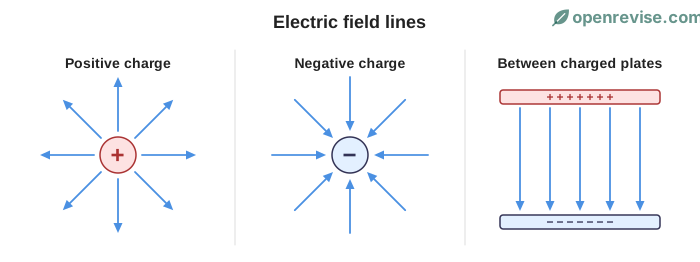
Field lines show the direction of the force on a small positive charge placed in the field.
- Around a positive charge, the lines point away from the charge, because a positive charge is repelled.
- Around a negative charge, the lines point towards the charge, because a positive charge is attracted.
- Between two parallel plates with opposite charges, the lines are straight, parallel and equally spaced, going from the positive plate to the negative plate. This is a uniform field: it has the same strength everywhere.
Field strength and distance
Where the field lines are close together, the field is strong. Where they are further apart, the field is weak.
The electric field around a charged sphere is strongest close to the surface and gets weaker as the distance from the sphere increases. A charged object feels a larger force when it is nearer to the other charge.
Explaining a spark
A charged object produces an electric field around it. When the charge is large, the field becomes so strong that it can pull electrons from the atoms in the air. The air is ionised and becomes able to conduct. Charge then flows through the ionised air in a spark.
For example, when you bring a charged object close to an earthed conductor, the field between them is strongest in the gap. A spark jumps when the field becomes strong enough to ionise the air.
Force on a charged object in a field
A charged object placed in an electric field experiences a force.
- A positive charge is pushed in the same direction as the field lines.
- A negative charge is pushed in the opposite direction to the field lines.
- The stronger the field (where the lines are closer together), the bigger the force. The force also depends on the size of the charge: a larger charge feels a larger force.
Example. Between two parallel plates, the top plate is positive and the bottom plate is negative. The field lines point downwards. A negatively charged dust particle between the plates is pushed upwards, towards the positive plate.
The field around two charges
- For two opposite charges, the field lines run from the positive charge to the negative charge. The charges attract.
- For two like charges, the field lines are pushed away from each other, and there is a point in the middle where the field is zero. The charges repel.
Why do sparks jump from points?
The field lines are closest together, and the field is strongest, near a sharp point on a charged object. This is why charge leaks away from a pointed object much more easily than from a smooth sphere, and why a lightning conductor has a pointed top. It also explains why a spark often jumps from your fingertip to a metal door handle.
How a spark starts
When a charged object has a large amount of charge, the electric field around it becomes very strong. The field is strong enough to pull electrons off the atoms in the air. The air is ionised, and charge can flow through it as a spark. The bigger the charge and the closer the object to the conductor, the stronger the field and the more likely a spark is.
Uses of electric fields
- Ink-jet printers give tiny drops of ink an electric charge, and then deflect them with charged plates, to place them accurately on the paper.
- Electrostatic spraying uses charged droplets that are attracted to an earthed object.
- Electrostatic precipitators use fields to pull charged smoke particles out of the chimney gases.
Test yourself on this lesson
9 exam questions · 19 marks · with mark schemes and model answers
Found a mistake?