3.1 Density
Density as mass per unit volume, the equation density = mass / volume, its units, and how the arrangement of particles explains the densities of solids, liquids and gases.
What is density?
Key terms
- Density: the mass of a substance in a given volume. It tells you how tightly packed the matter is.
- Mass: the amount of matter in an object, measured in kilograms (kg) or grams (g).
- Volume: the amount of space an object takes up, measured in cubic metres (m³) or cubic centimetres (cm³).
A block of lead feels much heavier than a block of wood of the same size. This is because lead has a greater density: there is more mass packed into the same volume.
The density equation
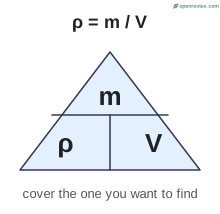
\rho = \frac{m}{V}
- \rho (the Greek letter "rho") is density in kilograms per cubic metre (kg/m³)
- m is mass in kilograms (kg)
- V is volume in cubic metres (m³)
Density is also often given in grams per cubic centimetre (g/cm³). To convert between the two:
1 \text{ g/cm}^3 = 1000 \text{ kg/m}^3
Worked example 1. A block of aluminium has a mass of 540 g and a volume of 200 cm³. Calculate its density.
\rho = \frac{m}{V} = \frac{540}{200} = 2.7 \text{ g/cm}^3
This is the same as 2700 kg/m³.
Worked example 2. Concrete has a density of 2400 kg/m³. Calculate the mass of 0.50 m³.
m = \rho V = 2400 \times 0.50 = 1200 \text{ kg}
Density and the particle model
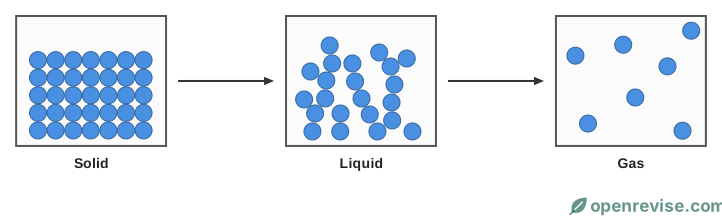
- In a solid, the particles are close together in a regular arrangement. Solids have a high density.
- In a liquid, the particles are also close together but can move past each other. Liquids have a similar density to solids, although it is usually slightly lower.
- In a gas, the particles are far apart. There are very few particles in a given volume, so gases have a very low density.
The mass of a substance does not change when it changes state, because the number of particles stays the same. What changes is the volume. When a substance is heated and expands, its mass is the same but its volume increases, so its density decreases.
Finding the volume or the mass from the density
Rearrange the equation to find the quantity that you need: m = \rho V and V = \frac{m}{\rho}.
Example 1. Aluminium has a density of 2700 kg/m³. Calculate the volume of 0.54 kg of aluminium.
V = \frac{m}{\rho} = \frac{0.54}{2700} = 0.000\,20 \text{ m}^3 = 200 \text{ cm}^3
Example 2. A gold ring has a volume of 0.30 cm³. The density of gold is 19.3 g/cm³.
m = \rho V = 19.3 \times 0.30 = 5.8 \text{ g}
Some typical densities
| Material | Density (kg/m³) |
|---|---|
| Air | 1.2 |
| Ice | 920 |
| Water | 1000 |
| Aluminium | 2700 |
| Iron | 7900 |
| Lead | 11 300 |
| Gold | 19 300 |
Floating and sinking
An object floats in a liquid if its density is less than the density of the liquid, and sinks if it is more. Ice (920 kg/m³) floats on water (1000 kg/m³). Lead sinks in water, but floats on mercury, which is a liquid metal with a much higher density.
Water is unusual. When water freezes, the particles move into an open arrangement, so the ice takes up about 9% more volume than the same mass of liquid water. The mass is the same, but the volume is bigger, so the density of ice is lower. This is why ice floats, and why water pipes can burst in winter.
Density and temperature
When a gas is heated, its particles move faster and the gas expands, so the volume gets bigger. The mass has not changed, so the density decreases. A hot-air balloon rises because the heated air inside it is less dense than the cooler air around it. Similarly, warm air rises above the radiator in a room, and cooler, denser air sinks to take its place.
Mixed units
Be careful when you use different units. If the mass is in grams (g) and the volume is in cm³, the density comes out in g/cm³. If it is kilograms and m³, it comes out in kg/m³. Do not mix them. Remember that 1 \text{ g/cm}^3 = 1000 \text{ kg/m}^3.
Test yourself on this lesson
9 exam questions · 22 marks · with mark schemes and model answers
Found a mistake?