1.9 Non-renewable energy resources
How coal, oil, gas and nuclear fuel are used to generate electricity, and their reliability, costs and effects on the environment.
Energy resources
Key terms
- Energy resource: a source of energy that we use to provide heating, electricity or fuel for transport.
- Non-renewable energy resource: a resource that is used up faster than it can be replaced, so it will eventually run out.
- Fossil fuels: coal, oil and natural gas, formed from the remains of dead plants and animals over millions of years.
- Carbon footprint: the amount of carbon dioxide and other greenhouse gases released by an activity.
A non-renewable resource cannot be replaced in a human lifetime. The non-renewable resources are the fossil fuels (coal, oil and natural gas) and nuclear fuels (uranium and plutonium).
Using fossil fuels to make electricity
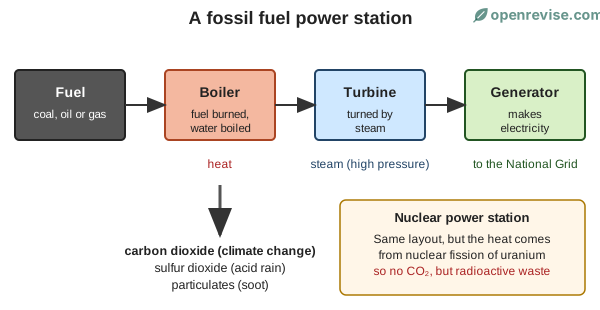
- The fuel is burned in a boiler. Energy is transferred from the chemical store of the fuel to the thermal store of the water.
- The water boils and becomes high-pressure steam.
- The steam turns a turbine.
- The turbine turns a generator, which produces electricity.
- The electricity goes to the National Grid.
A nuclear power station works in the same way, except that the heat comes from nuclear fission of uranium or plutonium, not from burning.
Fossil fuels in transport and heating
Oil is also used to make petrol, diesel and kerosene for cars and aeroplanes. Natural gas is used for cooking and heating homes.
Advantages and disadvantages
| Resource | Advantages | Disadvantages |
|---|---|---|
| Coal | Reliable; cheap; large reserves; power stations can be switched on when needed | Releases carbon dioxide (global warming), sulfur dioxide (acid rain) and soot; slow to start up |
| Oil | Reliable; used for transport fuels | Carbon dioxide and sulfur dioxide; oil spills damage wildlife |
| Natural gas | Reliable; produces less carbon dioxide than coal; quick to start up | Still releases carbon dioxide; reserves will run out |
| Nuclear | No carbon dioxide; very large amount of energy from a small mass of fuel; reliable | Radioactive waste that stays dangerous for thousands of years; risk of accidents; very expensive to build and to decommission |
Environmental effects
- Carbon dioxide is a greenhouse gas. More carbon dioxide in the atmosphere causes global warming and climate change.
- Sulfur dioxide dissolves in rain water and forms acid rain, which damages trees, buildings and lakes.
- Radioactive waste from nuclear power must be stored safely for a very long time.
Non-renewable resources are reliable: they do not depend on the weather, so power stations can supply electricity at any time. Gas power stations can be started in minutes, so they are used to meet sudden rises in demand.
How fossil fuels were formed
- Coal was formed from the remains of plants that grew in swamps and forests about 300 million years ago. The dead plants were buried under layers of mud and rock, and, over millions of years, heat and pressure turned them into coal.
- Oil and natural gas were formed from the remains of tiny sea creatures (plankton). These sank to the sea bed, were buried under sediment, and slowly changed by heat and pressure.
These processes take millions of years, so the fuels are being used much faster than they form. That is why they are non-renewable.
The efficiency of a power station
Example. A coal-fired power station has an input power of 2000 MW from burning coal, and an efficiency of 40%.
- Electrical output = 0.40 \times 2000 = 800 MW
- Wasted power = 2000 - 800 = 1200 MW
The wasted energy is transferred to the thermal store of the surroundings through the cooling towers and the chimney. Gas power stations can be more efficient, as they can use the hot exhaust gases to make extra steam.
Comparing carbon dioxide emissions
For the same amount of electricity, coal produces the most carbon dioxide. Natural gas produces about half as much as coal. Nuclear power produces almost none while the station is running. This is one reason why gas has replaced coal in many UK power stations.
Carbon capture
One idea for reducing the impact of fossil fuels is carbon capture and storage. The carbon dioxide from a power station is collected before it reaches the atmosphere and is pumped underground into old gas fields. The technology is expensive, and is not widely used yet.
Other issues with non-renewable resources
- Running out: reserves of fossil fuels and uranium are limited. When they are used up, they cannot be replaced.
- Security of supply: a country that has to import its fuel is affected by changes in price and by politics.
- Cost and time: power stations take several years to build. Nuclear power stations are especially expensive to build and to decommission (take apart safely) at the end of their lives.
- Jobs and the economy: mining and drilling provide jobs, but the fuels also cause pollution.
Test yourself on this lesson
9 exam questions · 23 marks · with mark schemes and model answers
Found a mistake?