1.10 Renewable energy resources and trends
Wind, hydroelectric, tidal, wave, solar, geothermal and bio-fuel resources, their reliability and environmental effects, and trends in UK energy use.
Renewable energy resources
Key terms
- Renewable energy resource: a resource that is replaced as fast as it is used, so it will not run out.
- Reliable: able to provide electricity whenever it is needed.
- Bio-fuel: a fuel made from plant or animal waste, for example wood or biogas.
- Demand: the amount of electricity that people want to use at a given time.
A renewable resource will not run out. Most renewable resources produce no carbon dioxide while they generate electricity.
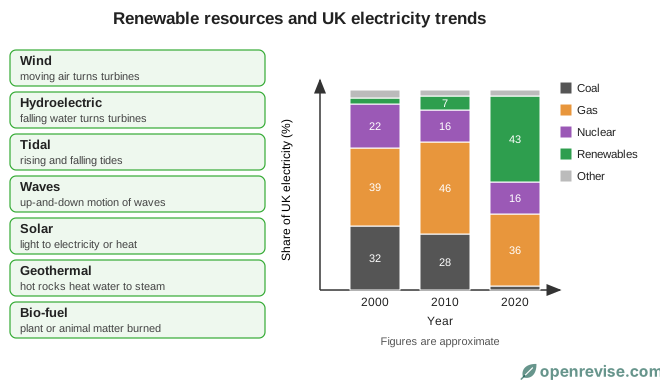
The resources
| Resource | How it works | Reliability | Environmental effects |
|---|---|---|---|
| Wind | Wind turns turbine blades connected to a generator | Not reliable: no wind, no electricity | Noise, spoils the view, can harm birds |
| Hydroelectric | Water falls from a reservoir through turbines | Fairly reliable and can start quickly | Flooding a valley destroys habitats and homes |
| Tidal | A barrage across an estuary holds back the tide; water flows through turbines | Reliable and predictable | Affects estuary wildlife; expensive to build |
| Waves | The movement of waves turns generators | Depends on the weather | Spoils the view; can harm sea life |
| Solar | Solar cells transfer light directly to electricity (solar panels can also heat water) | Only works in daylight and is weaker when cloudy | Needs large areas of land; manufacture uses energy |
| Geothermal | Water is pumped down to hot rocks and returns as steam to turn a turbine | Reliable | Only possible in certain places |
| Bio-fuel | Plant or animal waste is burned, or turned into fuel | Reliable | Needs land that could grow food; releases carbon dioxide (but plants take it back in as they grow) |
Reliability
Wind, wave and solar power depend on the weather, so they cannot supply electricity on demand. To keep the supply steady, they are used together with reliable resources such as gas, and energy can be stored, for example by pumping water uphill to a reservoir when there is spare electricity.
Trends in energy use
The way the UK generates electricity has changed a lot. The use of coal has fallen sharply, gas and renewables have grown and nuclear is stable. People in the UK now use more electricity for transport (electric cars) and heating (heat pumps).
Reasons for the changes include:
- concern about climate change and government targets to reduce carbon dioxide;
- the falling cost of wind and solar power as technology improves;
- the closing of old coal power stations;
- new laws and taxes on carbon emissions;
- public opinion and the demand for greener energy.
Some changes are slow because building power stations is expensive and takes many years, and because some people object to wind farms or new nuclear power stations near them.
Maximum power and average output
A wind turbine has a rating, which is its maximum output, for example 3.0 MW. Since the wind speed varies, the turbine usually produces much less than this, typically about 30% to 40% of its maximum, on average.
Example. A wind farm has 20 turbines, each rated at 3.0 MW.
- Maximum power = 20 \times 3.0 = 60 MW
- If the average output is 35% of the maximum, the average power = 0.35 \times 60 = 21 MW
Storing energy
Wind and solar power do not always match demand. Energy storage helps.
Pumped storage. When demand is low (at night), spare electricity is used to pump water uphill into a high reservoir. Energy is transferred from the electrical supply to the gravitational potential store of the water. When demand is high, the water is released and flows down through turbines, which turn generators. The gravitational potential store is transferred to the kinetic store of the water, and then to electricity. Pumped storage is about 70% to 80% efficient and can supply power within seconds. Batteries are used for smaller amounts of energy.
Solar power
Solar cells (photovoltaic cells) transfer energy from light directly to electricity, and are used on roofs, in calculators and in satellites. Solar water heaters transfer energy from the Sun to the thermal store of water. Solar power depends on the weather and time of day, and is much weaker in winter in the UK, when the demand for energy is greatest.
Cost
Renewable power stations are usually expensive to build, but they have no fuel costs, and low running costs. Fossil-fuel power stations are cheaper to build, but the fuel must be bought for as long as they operate. The cost of wind and solar power has fallen sharply in recent years.
Choosing a resource for a place
The best resource depends on the location. A windy hillside is good for a wind farm. A sunny country close to the equator is suitable for solar power. An estuary with a large tidal range is suited to a tidal barrage. A volcanic region such as Iceland is ideal for geothermal power. A good answer to a question about choosing a resource should refer to the location, the reliability, the cost and the environmental effects.
Test yourself on this lesson
9 exam questions · 28 marks · with mark schemes and model answers
Found a mistake?