1.5 Conservation and dissipation of energy
The law of conservation of energy, useful and wasted energy, dissipation to the surroundings and how lubrication and insulation reduce wasted energy.
The conservation of energy
Key terms
- Conservation of energy: the principle that energy cannot be created or destroyed, only transferred from one store to another.
- Useful energy: energy transferred to the stores we want it to go to.
- Wasted energy: energy transferred to stores that are not useful.
- Dissipated: spread out into the surroundings, mostly as thermal energy, so that it cannot easily be used again.
Energy cannot be created or destroyed. It can only be transferred usefully, stored or dissipated. The total energy at the start of a process is always equal to the total energy at the end.
Useful and wasted energy
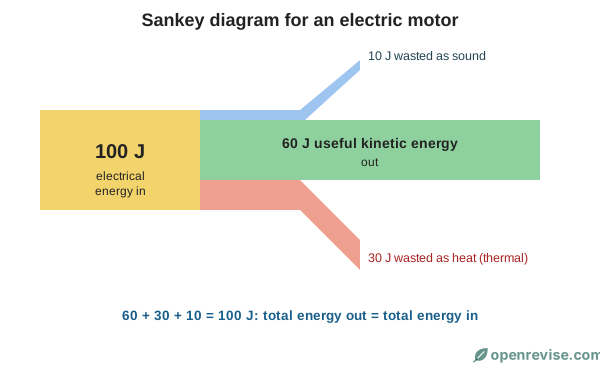
In any device, some of the energy is transferred to the stores we want (useful) and the rest goes to other stores (wasted). An electric motor is designed to produce movement, but it also gets hot and makes a noise:
- useful: kinetic energy;
- wasted: thermal energy (from friction between moving parts and from the resistance of the wires) and sound.
Wasted energy is dissipated to the surroundings. It spreads out, warming the air, so it is very hard to get it back. That is why we say it is "wasted", even though it has not been destroyed.
Sankey diagrams
A Sankey diagram shows energy transfers. The width of each arrow is drawn in proportion to the amount of energy. The arrow going in is the total input, the arrow continuing straight on is the useful output, and the arrows going off to the side are the wasted energy.
For the motor above:
\text{total input} = \text{useful output} + \text{wasted energy}
100 = 60 + 30 + 10
Reducing unwanted energy transfers
We cannot stop energy from dissipating, but we can reduce the amount wasted.
- Lubrication: oil or grease between moving parts reduces friction, so less energy is transferred to the thermal store. Bike chains and car engines are oiled for this reason.
- Thermal insulation: materials that are poor conductors, such as foam or fibreglass, reduce the rate of energy transfer by heating to the surroundings.
- Streamlining: shaping a vehicle reduces air resistance, so less energy is wasted.
Energy transfers in everyday devices
| Device | Useful energy transfer | Main wasted energy transfers |
|---|---|---|
| Filament lamp | Electrical to light | Thermal (most of the energy) |
| LED lamp | Electrical to light | Thermal (a smaller amount) |
| Television | Electrical to light and sound | Thermal |
| Electric motor | Electrical to kinetic | Thermal and sound |
| Petrol car engine | Chemical to kinetic | Thermal (engine and exhaust), sound |
| Electric heater | Electrical to thermal in the room | Almost none: nearly all of it is useful |
In nearly every case, the wasted energy ends up in the thermal store of the surroundings.
Using the numbers
\text{wasted energy} = \text{total input energy} - \text{useful output energy}
Example. A hairdryer takes in 1000 J of electrical energy. The heater transfers 750 J to the thermal store of the air, the fan transfers 150 J to the kinetic store of the air, and the rest is wasted as sound.
Wasted as sound = 1000 - 750 - 150 = 100 J.
The energy in equals the energy out: 750 + 150 + 100 = 1000 J, so energy is conserved.
A bouncing ball
A ball dropped from 1.0 m does not bounce back up to 1.0 m. At each bounce, part of the ball's kinetic energy is transferred to the thermal stores of the ball and the floor, and some is transferred to the surroundings as sound. So less energy is available to be transferred to the gravitational potential store as the ball rises, and the next bounce is lower. No energy has disappeared: it has been dissipated.
Why can't we reuse dissipated energy?
Dissipated energy is shared among a huge number of particles in the surroundings, and it raises their temperature only very slightly. The energy is spread out, so it is almost impossible to collect it again to do something useful. We can reduce how much is wasted, but not eliminate it.
Perpetual motion
A perpetual motion machine is a machine that would keep running forever without any energy supply. It is impossible, because every real machine transfers some energy to the thermal store of the surroundings. Without a supply of new energy, the machine would eventually stop. Any design that claims to produce more useful energy than it takes in would break the law of conservation of energy.
Test yourself on this lesson
9 exam questions · 17 marks · with mark schemes and model answers
Found a mistake?