1.6 Efficiency
How to calculate efficiency from energy or power as a decimal or percentage, and ways to make machines more efficient.
What is efficiency?
Key terms
- Efficiency: the fraction of the total energy supplied to a device that is transferred usefully.
- Useful output energy: the energy transferred to the stores we want.
- Total input energy: all of the energy supplied to a device.
Every device wastes some energy, so its efficiency is always less than 1 (or less than 100%). The closer the efficiency is to 1, the less energy is wasted.
Calculating efficiency
You can also use power in the same way:
The answer is a decimal between 0 and 1. Multiply by 100 to give a percentage:
\text{efficiency (\%)} = \frac{\text{useful output}}{\text{total input}} \times 100
Example 1. A motor takes in 500 J of electrical energy and transfers 350 J usefully.
\text{efficiency} = \frac{350}{500} = 0.70, or 70%.
Example 2. An LED lamp has a power input of 8 W and a useful light output of 2 W.
\text{efficiency} = \frac{2}{8} = 0.25, or 25%.
Comparing devices
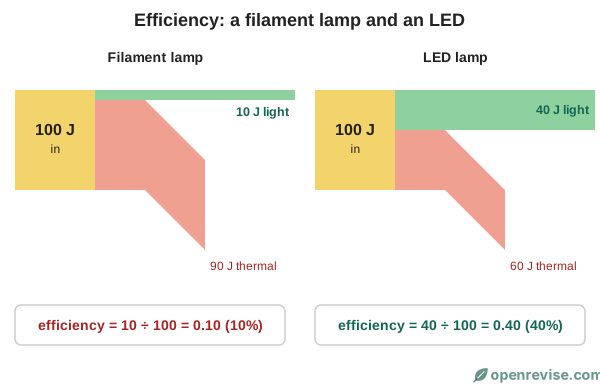
The diagram shows two lamps that each take in 100 J. The filament lamp transfers only 10 J as light, and the other 90 J is wasted as heat, so its efficiency is 0.10. The LED transfers 40 J as light, so its efficiency is 0.40. The LED is four times as efficient, which is why LED bulbs have replaced filament bulbs: they cost less to run.
Rearranging the equation
To find the useful output, multiply the efficiency by the total input:
\text{useful output} = \text{efficiency} \times \text{total input}
Example. A 2000 J input to a machine that is 60% efficient gives 0.60 \times 2000 = 1200 J of useful energy.
Increasing efficiency
Higher tier students may be asked how to make a device more efficient. The idea is always to reduce the energy transferred to unwanted stores:
- lubricate moving parts to reduce friction;
- use thermal insulation to reduce unwanted heating of the surroundings;
- use streamlined shapes to reduce air resistance;
- use materials with lower electrical resistance, so less energy is transferred as heat in the wires.
Efficiency from power
The idea works for the rate of energy transfer, as well as for the energy. Example. A lift motor has an input power of 5.0 kW and a useful output power of 3.5 kW.
\text{efficiency} = \frac{3.5}{5.0} = 0.70, or 70%. The wasted power is 5.0 - 3.5 = 1.5 kW.
Finding the wasted energy
\text{wasted energy} = \text{total input} - \text{useful output} = \text{total input} \times (1 - \text{efficiency})
Example. A machine that is 60% efficient takes in 2000 J. The useful output is 0.60 \times 2000 = 1200 J, so the wasted energy is 2000 - 1200 = 800 J.
Typical efficiencies
| Device | Typical efficiency |
|---|---|
| Filament lamp | about 10% |
| LED lamp | about 25% to 40% |
| Petrol car engine | about 25% to 30% |
| Coal-fired power station | about 35% to 40% |
| Electric motor | about 70% to 90% |
| Large transformer | about 95% to 99% |
Efficiency and cost
Example. A filament lamp has an input power of 20 W and an efficiency of 10%. An LED lamp gives the same useful light, 2.0 W (0.10 \times 20 = 2.0 W), but only needs an input power of 8.0 W.
Over 1000 hours of use:
- the filament lamp transfers 20 \text{ W} \times 1000 \text{ h} = 20 kWh, which costs 20 × 30p = £6.00;
- the LED lamp transfers 8.0 \times 1000 = 8.0 kWh, which costs 8.0 × 30p = £2.40.
The LED saves £3.60 in electricity every 1000 hours. LED bulbs cost more to buy, but this extra cost is soon paid back.
Efficiency of a whole system
If a process has several stages, the overall efficiency is found by multiplying the efficiencies. A power station that is 40% efficient (0.40) sends its electricity through cables that are 95% efficient (0.95): the overall efficiency is 0.40 \times 0.95 = 0.38, or 38%.
Why is efficiency never 100%?
Some of the energy is always transferred to the thermal store of the surroundings, by friction, by the resistance of wires, or by air resistance. This energy is dissipated. We can reduce the wasted energy, but we can never get rid of it, so no real device is 100% efficient.
Test yourself on this lesson
9 exam questions · 18 marks · with mark schemes and model answers
Found a mistake?