1.4 Work done and power
Work done as force times distance, power as the rate of transferring energy, and how to calculate both with the correct units.
Work done
Key terms
- Work done: the energy transferred when a force moves an object through a distance.
- Joule: the unit of work and energy. One joule is the work done when a force of one newton moves an object one metre.
- Power: the rate at which energy is transferred, or the rate at which work is done.
- Watt: the unit of power. One watt is one joule of energy transferred each second.
When a force moves an object, energy is transferred. The amount of energy transferred is the work done.
- W = work done in joules (J)
- F = force in newtons (N)
- s = distance moved in the direction of the force in metres (m)
So 1 J = 1 N m.
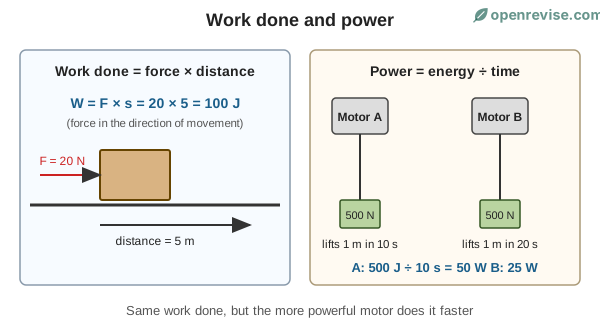
Example. A person pushes a box with a force of 20 N for 5.0 m.
W = 20 \times 5.0 = 100 J
Work done against friction
When you push a box along the floor, you do work against the force of friction. The energy you transfer does not go into a gravitational or kinetic store of the box. Instead, it is transferred to the thermal stores of the box, the floor and the surroundings, so they get a little warmer. This is why rubbing your hands together makes them feel warm.
Power
Two people can do the same amount of work in different times. The one who does it faster has more power.
- P = power in watts (W)
- E = energy transferred in joules (J)
- W = work done in joules (J)
- t = time in seconds (s)
1 watt = 1 joule per second (1 W = 1 J/s). A 60 W lamp transfers 60 J every second.
Example. A motor lifts a load and does 600 J of work in 12 s.
P = \frac{600}{12} = 50 W
Rearranging
- E = P t
- t = \frac{E}{P}
Example. How much energy does a 2000 W kettle transfer in 3 minutes? Convert the time first: 3 × 60 = 180 s. Then E = 2000 \times 180 = 360\,000 J, which is 360 kJ.
Work done and energy stores
When work is done, energy is transferred, and the work done is equal to the energy transferred. What the energy is transferred to depends on the situation.
- Lifting an object at a steady speed: the work done equals the gain in gravitational potential energy.
- Stretching a spring: the work done is transferred to the elastic potential store.
- Pushing a box at a steady speed along the floor: the work done against friction is transferred to the thermal store.
- Speeding up a trolley: the work done equals the gain in kinetic energy.
Example 1: lifting. A 20 kg box is lifted through 1.5 m at a steady speed. The force needed is equal to the weight, F = m g = 20 \times 9.8 = 196 N. The work done is W = F s = 196 \times 1.5 = 294 J. This is the same as the gain in gravitational potential energy, m g h = 20 \times 9.8 \times 1.5 = 294 J.
Example 2: finding the force. A tractor does 54 000 J of work pulling a trailer along 90 m of ground. F = \frac{W}{s} = \frac{54\,000}{90} = 600 N.
Distance in the direction of the force
Only the movement in the direction of the force counts. If you carry a bag along a level corridor, the force that you use to hold the bag is upwards, but the bag moves horizontally, so you do no work on the bag. In the same way, a waiter holding a tray stationary does no work on the tray.
Power in everyday life
| Device or situation | Typical power |
|---|---|
| LED lamp | 10 W |
| Laptop | 60 W |
| A person at rest or walking slowly | about 100 W |
| Electric kettle | 2200 W (2.2 kW) |
| Car engine at a steady speed | about 20 000 W (20 kW) |
| Wind turbine at full output | 2 000 000 W (2 MW) |
Large powers are often given in kilowatts (kW), where 1 kW = 1000 W, and megawatts (MW), where 1 MW = 1 000 000 W. Remember to change them back to watts before you use them in an equation.
Example 3: climbing stairs. A student of mass 60 kg climbs a flight of stairs 3.0 m high in 6.0 s.
- Work done = m g h = 60 \times 9.8 \times 3.0 = 1764 J
- Power = \frac{1764}{6.0} = 294 W
So for those 6 seconds the student has a power output of about 300 W, three times that of a 100 W lamp.
Comparing machines
Two machines can do the same job, but the one with the greater power does it faster. In the same time, the machine with the greater power does more work. When you compare machines, make sure you compare the energy transferred and the time taken.
Test yourself on this lesson
9 exam questions · 19 marks · with mark schemes and model answers
Found a mistake?