1.7 Thermal conductivity and insulation
How thermal conductivity and thickness affect the rate of energy transfer through a material, and how loft insulation, cavity walls and double glazing reduce heat loss from a house.
Conduction and thermal conductivity
Key terms
- Thermal conductivity: a measure of how well a material conducts thermal energy. The higher the thermal conductivity, the faster energy is transferred through it.
- Conduction: the transfer of thermal energy through a material, from particle to particle, with no movement of the material itself.
- Insulator: a material with a low thermal conductivity, which transfers energy slowly.
Metals are good conductors because they have free electrons that carry energy quickly through the material. Air, wool, foam and fibreglass are poor conductors. They are insulators.
The rate at which a material transfers energy depends on:
- the material: the higher its thermal conductivity, the faster the transfer;
- the thickness: a thicker wall transfers energy more slowly;
- the temperature difference between the inside and the outside.
So a house with thick walls made of a material with a low thermal conductivity cools down slowly and needs less energy to keep it warm.
Heat losses from a house
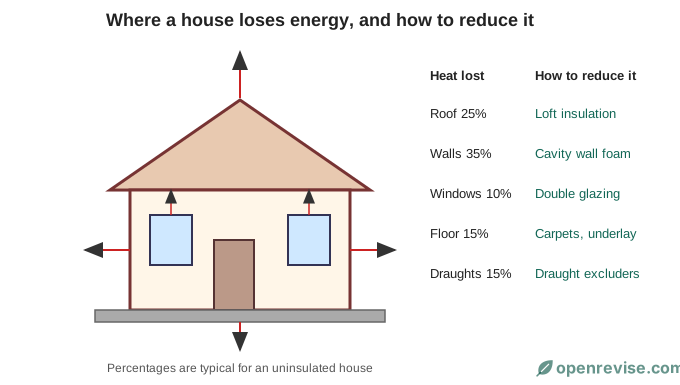
Energy is transferred from a warm house to the cold air outside through the roof, walls, windows, floor and gaps around doors and windows.
Reducing the rate of energy transfer
| Method | How it works |
|---|---|
| Loft insulation | A thick layer of fibreglass or mineral wool traps air, which is a poor conductor, and reduces conduction through the roof |
| Cavity wall insulation | Foam is pumped into the gap between the two layers of brick. It stops air moving (convection) and reduces conduction |
| Double glazing | Two panes of glass with a gap of air or a vacuum between them. This reduces conduction through the window |
| Draught-proofing | Seals gaps around doors and windows so warm air cannot escape |
| Carpets and floor insulation | Reduce conduction through the floor |
Trapped air is a very good insulator because the air particles are far apart and so pass on energy slowly, and trapped air cannot move to carry energy by convection.
Is insulation worth it?
Insulation costs money to install but saves money on heating bills. The payback time is the time taken for the savings to equal the cost:
\text{payback time} = \frac{\text{cost of installation}}{\text{annual saving}}
For example, loft insulation that costs £300 and saves £100 a year pays for itself in 3 years. Cheaper methods with a short payback time, like draught-proofing, are often installed first.
Conduction at the level of particles
In a solid, the particles vibrate about fixed positions. When one end of a solid is heated, the particles there vibrate more strongly, and they pass on this extra energy to their neighbours by collisions. The energy is passed along the solid from particle to particle.
Metals conduct much better than other solids because they contain free (delocalised) electrons. These move through the metal and carry energy quickly. Materials such as wood, plastic and wool have no free electrons, so energy is passed on only by vibrations, which is slower. Gases are poor conductors because their particles are far apart, so collisions are less frequent.
| Material | Thermal conductivity |
|---|---|
| Copper | Very high |
| Brick | Fairly low |
| Fibreglass and foam | Very low |
| Still air | Extremely low |
Convection and radiation
Energy is also transferred from a warm house by convection and by radiation.
- Convection: warm air rises, and colder air takes its place, so energy is carried through the house. Draughts through gaps carry energy out, too.
- Radiation: warm walls and windows give out infrared radiation.
Insulation tackles each of these. Loft insulation and cavity wall insulation trap pockets of air, which reduces conduction and stops the air from circulating, so reduces convection. Draught-proofing reduces the movement of air through gaps. Shiny foil behind a radiator reflects infrared radiation back into the room.
Payback time: comparing two options
\text{payback time} = \frac{\text{cost}}{\text{saving per year}}
| Method | Cost | Saving per year | Payback time |
|---|---|---|---|
| Draught-proofing | £120 | £60 | 2 years |
| Loft insulation | £300 | £100 | 3 years |
| Double glazing | £4000 | £80 | 50 years |
Draught-proofing and loft insulation pay for themselves quickly. Double glazing has a payback time of 50 years, which is probably longer than the life of the windows, so it is poor value if the only aim is to save money. Homeowners may still choose it for other reasons, such as noise reduction and comfort.
Test yourself on this lesson
9 exam questions · 21 marks · with mark schemes and model answers
Found a mistake?